Rockford Fosgate Power 1000 MOSFET
The Amplifier That Became an American Car Audio Legend
Power 300, Power 650, and the 1000 that stood at the top
When talking about American car audio in the early 1990s, there is one amplifier that deserves a special place in history.
The Rockford Fosgate Power 1000.
By today’s standards, 150 watts × 4 may not sound particularly impressive. But when this amplifier appeared, the story was very different.
The Power 1000 was more than just a powerful amplifier. It represented how far Rockford Fosgate was willing to push high-performance car audio during an era when American car audio was rapidly evolving.
And the story becomes even more interesting when the Power 1000 leads into the legendary Chrome Power 1000C and Terminator Edition.
The Power Series — From the 300 to the 1000
To understand the Power 1000, we first need to look at the Power Series itself.
The early Power MOSFET lineup included the Power 300, Power 650, and Power 1000.
The Power 300 was a four-channel amplifier rated at 50 watts × 4 into 4 ohms. As the lineup moved upward, both power and scale increased dramatically.
At the top sat the Power 1000.
According to Rockford Fosgate’s original documentation, the Power 1000 MOSFET was rated at 150 watts × 4 into 4 ohms, increasing to 250 watts × 4 into 2 ohms.
In bridged operation, it could deliver 500 watts × 2 into 4 ohms.
For a four-channel car amplifier of its era, those were serious numbers.
The Power 1000 Wasn’t Simply a “1,000-Watt Amplifier”
The name can be misleading.
The Power 1000 was not simply a 1,000-watt RMS amplifier.
Its primary specification was 150 watts × 4 at 4 ohms, with 250 watts × 4 at 2 ohms and 500 watts × 2 when bridged.
The “1000” was not simply a representation of its total RMS output.
Instead, it represented the position the amplifier held within Rockford Fosgate’s flagship Power lineup.
The design philosophy was more important than the number itself.
The Power 1000 was engineered as a serious high-performance amplifier for automotive applications, with substantial power handling, filtering, noise suppression, and protection circuitry.
It was also designed to operate across the voltage range found in automotive, marine, and other battery-powered applications.
The Price Tells the Story
One of the easiest ways to understand how special the Power 1000 was is to look at its original price.
Contemporary material lists the Power 1000 at approximately $2,650 MSRP.
That was an extraordinary amount of money for a car amplifier in the early 1990s.
This wasn’t a mass-market amplifier designed simply to add more power to an everyday car.
The Power 1000 was aimed at enthusiasts who wanted to build an uncompromising high-end car audio system.
In that sense, the Power 1000 wasn’t merely a powerful amplifier.
It represented the upper limits of American car audio at the time.
Enter Wayne Harris
There is another important name connected to the story of the Power 1000:
Wayne Harris.
Wayne Harris became a well-known figure in the world of old-school American car audio, and his name is closely associated with the legendary Terminator Hearse.
During this period, Wayne modified a Power 1000 for his own vehicle.
One of the problems was the amplifier’s physical size.
The original amplifier had a long rear section, often referred to as the “caboose.”
Because of the installation requirements in his vehicle, the amplifier was shortened.
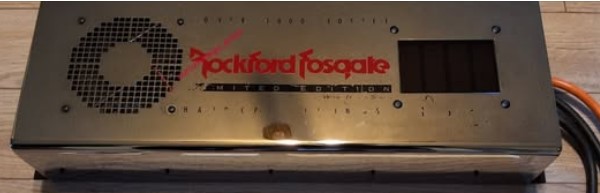
He then added an LED bar-graph display and finished the amplifier in chrome.
The result looked completely different from the standard black Power 1000.
When a Car Amplifier Became a Work of Art
Wayne Harris’s modified Power 1000 was more than a functional upgrade.
The combination of the chrome finish and LED display transformed the amplifier into something visually distinctive.
The LED display was not merely decorative. It was part of the visual concept associated with the Terminator project.
The design attracted attention, including from Rockford Fosgate itself.
Eventually, ideas from this project would influence the development of the production Power 1000C.
And this is where the story gets particularly interesting.
Power 1000 → Terminator Edition → Power 1000C
This is also where confusion often begins.
The original Power 1000 featured the traditional black finish and the longer rear section.
Later versions appeared with a shorter chassis configuration and chrome finishes, eventually leading to the distinctive LED-equipped chrome models.
Along the way, a very limited number of Terminator Edition amplifiers were produced.
Contemporary accounts describe the Terminator Edition as an extremely limited production run of approximately 100 units.
These were not simply standard Power 1000 amplifiers with a chrome finish.
The Terminator Edition was a distinct and highly collectible version associated with Wayne Harris and the Terminator project.
Rockford Fosgate later brought elements of this concept into production with the Power 1000C.
Chrome Does Not Automatically Mean Terminator
This distinction is important for collectors today.
Not every chrome Power 1000 is a Terminator Edition.
The Terminator Edition carried its own identifying markings, including specific “Terminator Edition” graphics.
The production Power 1000C, on the other hand, was a factory-developed model.
That means a chrome Power 1000 should not automatically be described as a Terminator Edition simply because it has a chrome finish.
For collectors, this distinction can make a significant difference.
The Power 1000C
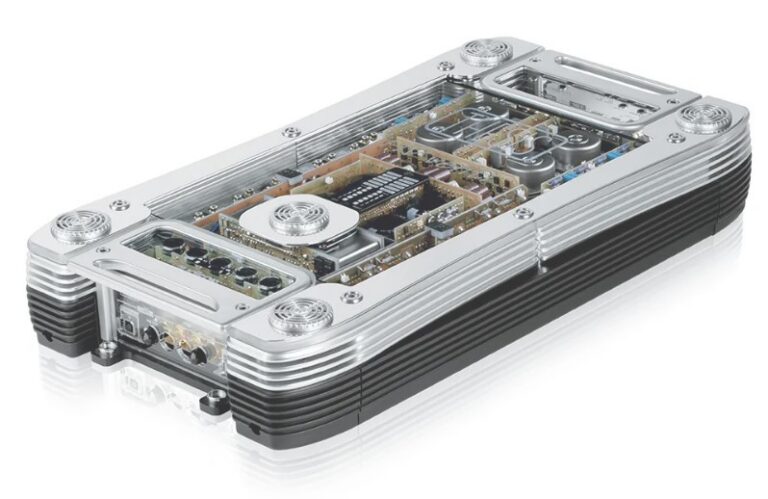
The most obvious feature of the Power 1000C is its appearance.
A large chrome amplifier body.
A distinctive LED output display.
And the kind of physical presence that modern compact amplifiers simply don’t have.
This was a different era.
Amplifiers were not always hidden away.
They were often displayed in the trunk as part of the installation itself.
The amplifier became part of the visual identity of the system.
The Power 1000C represents that philosophy perfectly.
Why Did the Power 1000 Become a Legend?
The Power 1000’s legacy isn’t based on power alone.
First, the era.
The late 1980s and early 1990s were an important period in the development of American car audio.
Competition was intense, amplifier technology was advancing quickly, and enthusiasts were pushing systems further than ever before.
Second, the scale.
The Power 1000 was a massive four-channel amplifier for its time, capable of 150 watts × 4 into 4 ohms.
Third, the design.
The evolution from the black Power 1000 to the chrome 1000C created a visual identity that became instantly recognizable.
And finally, rarity.
The extremely limited Terminator Edition added another layer to the Power 1000 story.
That combination of performance, design, history, and rarity is what makes these amplifiers so interesting today.
The 300 and 650 Made the 1000 More Special
Looking at the Power 1000 by itself, it can simply appear to be a massive old amplifier.
But when you see it as part of the original Power lineup, the story becomes clearer.
Power 300 → Power 650 → Power 1000
The three models show how Rockford Fosgate structured its high-performance Power Series.
The 300 and 650 were important parts of that lineup.
But the 1000 stood at the top.
They may be supporting characters in this story, but they help explain why the Power 1000 was such a significant amplifier.
Looking Back at the Power 1000 Today
Modern car amplifiers are smaller, lighter, more efficient, and capable of producing dramatically more power.
Many now incorporate DSP functionality, networking, and Class D technology.
Compared with those products, the Power 1000 can look almost excessive.
But that’s exactly what makes it interesting.
It doesn’t represent the latest technology.
It represents what car audio enthusiasts dreamed about during a particular era.
The enormous chassis.
The weight.
The traditional analog circuitry.
The substantial power supply.
And the unmistakable LED meters.
Today, some of these characteristics may seem inefficient.
Back then, they were part of the definition of high-end car audio.
K Sound Gear Perspective
I don’t think the Rockford Fosgate Power 1000 should be remembered simply as “an old amplifier that was powerful.”
Its real significance lies in several things:
It was the flagship of the early Power Series.
It represented Rockford Fosgate’s ambition during the golden age of American car audio.
And through Wayne Harris and the Terminator project, it became part of a story where performance and visual design came together.
Even decades later, a chrome Power 1000 still commands attention.
It captures something that is difficult to reproduce with modern equipment:
The attitude of American car audio in its golden era.
Bigger.
Stronger.
And impossible to ignore.
That was the spirit of the era.
And the Rockford Fosgate Power 1000 remains one of the amplifiers that represents it best.
Not simply an amplifier.
A piece of American car audio history.