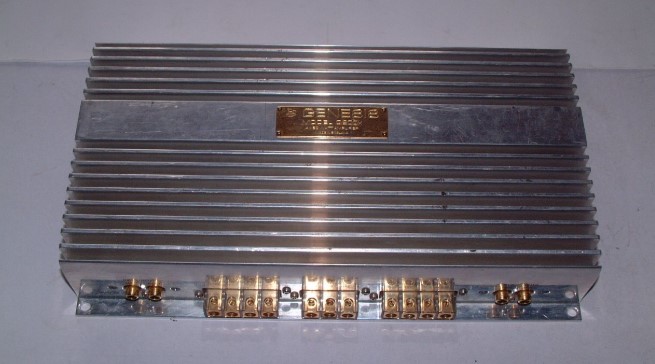
Genesis Q200X
When Sound Quality Came First
There was a time when car audio was not simply about power.
Before massive amplifiers, enormous power ratings, and endless competition for bigger numbers, there were products designed with a very different philosophy.
The goal was simple:
Make music sound right.
The Genesis Q200X is one of those amplifiers.
A classic four-channel amplifier from the golden era of European car audio, the Q200X was never designed to impress with outrageous power figures.
Instead, it was built around something far more difficult to measure:
musicality.
A Different Kind of Car Audio
The 1990s were an interesting period for car audio.
American manufacturers were producing powerful amplifiers aimed at high-output systems and SPL competition, while European manufacturers were developing equipment with a much stronger emphasis on sound quality.
Genesis became one of the names associated with this European SQ movement.
The philosophy was different.
Instead of asking only how much power an amplifier could produce, designers also had to consider how naturally it reproduced music.
Detail.
Tonality.
Control.
Imaging.
And most importantly, how enjoyable the system was to listen to.
The Q200X belongs to this generation of equipment.
It may not be the largest or most intimidating amplifier, but it was designed for people who cared about what happened after the music left the amplifier.
Four Channels, One Purpose
The Q200X is a four-channel amplifier.
Its rated output is approximately:
- 50W × 4 @ 4Ω
- 90W × 4 @ 2Ω
- 180W × 2 bridged @ 4Ω
On paper, those numbers may seem modest by today’s standards.
But this is where the Q200X becomes interesting.
Independent testing has measured approximately 81W × 4 at 4Ω, while bridged operation produced approximately 246W × 2 at 4Ω, for a measured total output of around 492 watts.
In other words, the Q200X had considerably more capability than its conservative rating might suggest.
But even those numbers don’t really explain why the Q200X became an amplifier remembered by SQ enthusiasts.
Class AB — Done the Genesis Way
The Q200X is a Class AB amplifier.
Genesis offered several different amplifier designs during this era, including models with stronger Class A operation, while the Q200X was positioned in the Class AB portion of the range.
The official DLS/Genesis documentation lists the Q200X as a Class AB model and specifies its 4-channel output configuration.
That distinction is important.
The Q200X was not trying to imitate a massive Class A home-audio amplifier inside a car.
Instead, it used a practical Class AB architecture capable of delivering useful power while maintaining the characteristics expected from a serious SQ amplifier.
It was a compromise — but a carefully engineered one.
And that is often what separates a good amplifier from a great one.
More Than Just a Power Rating
One of the most interesting things about the Q200X is how conservative the numbers look compared with its actual performance.
The published specifications list 50 watts per channel at 4 ohms.
Independent measurements tell a different story.
At 13.4 volts, the amplifier produced approximately 81 watts × 4 at 4 ohms.
In bridged operation, approximately 246 watts × 2 was measured at 4 ohms.
The measured total output was approximately 492 watts.
That is a very different picture from simply calling it a “50-watt amplifier.”
And it tells us something about the engineering philosophy of the era.
The Q200X didn’t need an impressive number printed on the chassis.
It had the performance to back itself up.
Built for Real Systems
Another important feature of the Q200X is its flexibility.
The amplifier was designed for multi-channel car audio systems and included built-in active crossover functionality.
The DLS/Genesis documentation lists the Q200X among the Genesis amplifiers equipped with active filters.
This made it possible to build sophisticated systems without necessarily requiring a separate crossover processor for every application.
For example, a Q200X could be used in a front-and-rear system, a front-stage system, or in a configuration involving bridged channels.
For its time, this was an extremely practical approach.
A Natural Choice for a Two-Way Front Stage
This is where the Q200X becomes especially interesting for modern SQ enthusiasts.
A four-channel amplifier is a natural match for a fully active two-way front stage.
Two channels for the left side.
Two channels for the right side.
With a suitable DSP controlling the crossover and time alignment, the Q200X can become the power stage behind a very sophisticated two-way system.
And this combination makes sense even today.
The DSP handles the precision.
The speakers determine the character.
And the amplifier provides the power and control needed to bring the system to life.
The Q200X doesn’t need to be the star of the system.
In fact, it is probably better when it isn’t.
A good amplifier should allow the rest of the system to perform.
The Sound Quality Philosophy
So what makes the Q200X a true SQ amplifier?
It isn’t simply the fact that it is a four-channel Class AB design.
It is the philosophy behind the product.
Sound quality systems are ultimately about balance.
Too much emphasis on detail can make a system aggressive.
Too much warmth can make it soft.
Too much power without control can make the system sound excessive.
The goal is to find the point where everything comes together naturally.
That is why amplifiers such as the Q200X remain interesting.
They were designed during an era when installers spent enormous amounts of time matching amplifiers, speakers, sources, and crossovers.
The amplifier was not selected simply because it produced the most watts.
It was selected because it worked with the rest of the system.
The Character of Old-School Genesis
There is something special about the appearance of an old Genesis amplifier.
The long finned heatsink.
The understated metal chassis.
The gold-colored Genesis badge.
The heavy terminals.
Nothing about it looks modern.
And that is precisely why it looks so good.
It belongs to an era when high-end car audio equipment had a physical presence.
You could look at the amplifier and immediately understand that it was built as a serious piece of hardware.
The Q200X doesn’t need RGB lighting.
It doesn’t need a giant power rating printed across the top.
It simply sits there, quietly waiting for the music.
Engineering You Can See
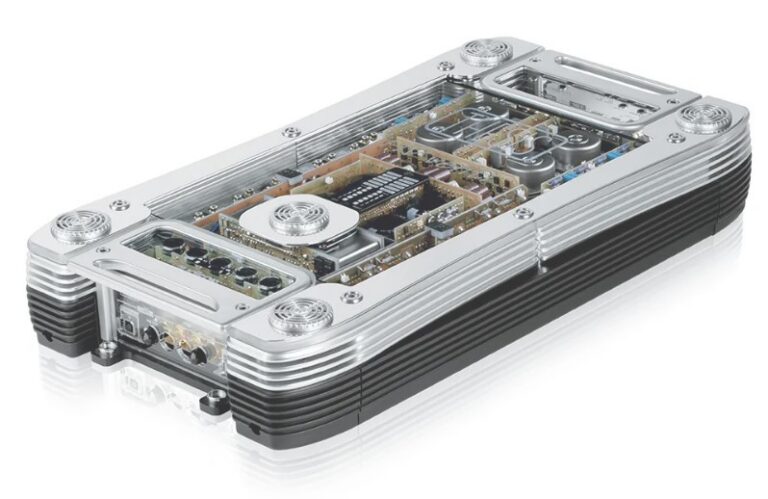
Remove the cover and the Q200X becomes even more interesting.
The internal layout reveals a serious power supply and a substantial analog signal path.
Independent measurements have recorded approximately 38.2A of current draw during four-channel output testing and approximately 67.1A under bridged operation.
The measured efficiency was approximately 63.3% in the four-channel test.
For a relatively compact amplifier from this era, those numbers help explain why the Q200X can deliver considerably more real-world performance than its modest exterior might suggest.
This is old-school amplifier engineering.
No digital display.
No app.
No firmware.
Just power supply, analog circuitry, transistors, capacitors, and careful engineering.
Then and Now
Modern car audio has changed dramatically.
Today’s DSPs can perform precise time alignment, sophisticated EQ, multiple crossover types, phase adjustment, and much more.
Modern amplifiers can also produce enormous amounts of power from surprisingly small chassis.
So why should anyone still care about a Q200X?
Because technology isn’t the whole story.
The Q200X represents a period when car audio engineers were trying to solve the same fundamental problem we still have today:
How do we make a car sound like music instead of a collection of electronic components?
The tools have changed.
The goal hasn’t.
Not Built to Shout
The Q200X was never meant to be an SPL monster.
It was designed for people who cared about the quality of the listening experience.
That distinction matters.
There are amplifiers designed to shake the car.
There are amplifiers designed to win competitions.
And then there are amplifiers designed to make you sit in the driver’s seat after the installation is finished and simply listen to another song.
The Q200X belongs much closer to the third category.
A Classic for SQ Enthusiasts
Imagine a system built around a high-quality two-way front stage.
A capable DSP handles the crossover and time alignment.
A carefully chosen midwoofer handles the lower and midrange frequencies.
A refined tweeter takes care of the top end.
And behind everything sits a Genesis Q200X.
No unnecessary complexity.
No enormous amplifier rack.
Just four channels of carefully engineered analog power.
That is a system that makes sense.
And that is where the Q200X still feels relevant.
Why the Q200X Still Matters
The Genesis Q200X is now a product from another era.
It is not the smallest amplifier.
It is not the most powerful.
It does not have modern digital features.
But none of that makes it irrelevant.
In fact, those limitations are part of its character.
The Q200X reminds us that great car audio was never only about technology.
It was about matching the right components together.
It was about listening.
It was about tuning.
And ultimately, it was about music.
K Sound Gear
At K Sound Gear, we don’t want to simply collect specifications.
We want to remember the products that helped shape car audio.
The Genesis Q200X is one of them.
It represents a time when a serious car audio system could be built around a carefully chosen analog amplifier, a good set of speakers, and an installer who understood how to make the pieces work together.
Today, DSP technology gives us incredible control.
But the fundamental question remains the same:
Does it make you want to keep listening?
That is the question the Q200X was designed to answer.
Not with a huge number.
Not with a flashy design.
But with music.
Genesis Q200X
Four channels.
Serious engineering.
And a philosophy that put Sound Quality first.
K Sound Gear
Classic Car Audio · Sound Quality · The Stories Behind the Gear