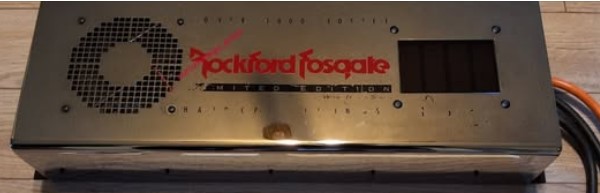
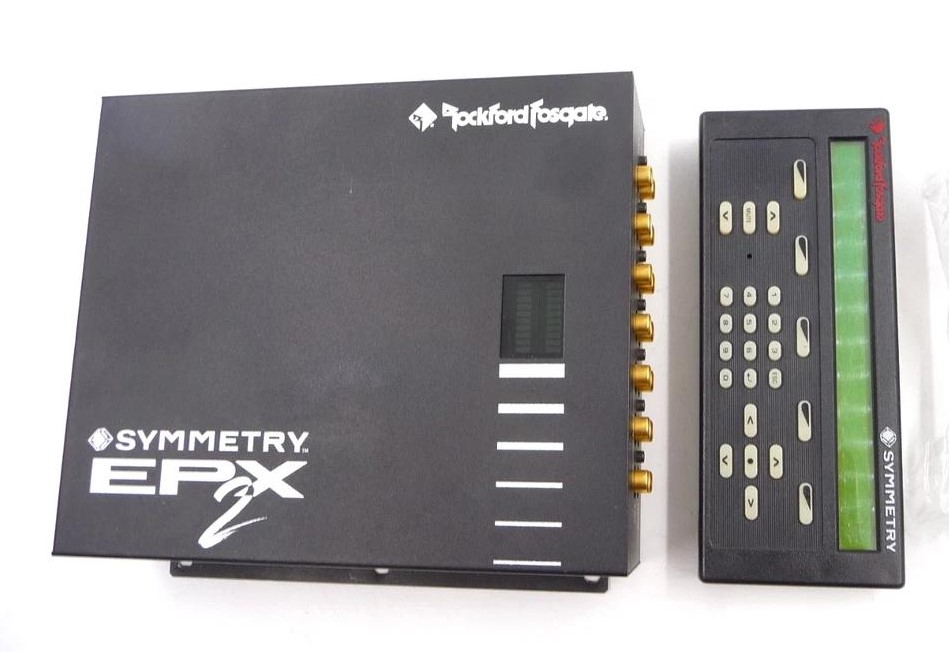
Rockford Fosgate Symmetry EPX2
A Digital Car Audio Revolution of the 1990s
Rockford Fosgate Symmetry EPX2
Today, DSPs are an essential part of modern car audio.
Adjusting crossovers, EQ, time alignment, and phase using a computer or smartphone has become completely normal.
But about 30 years ago, there was already a product that brought many of these digital processing concepts into car audio.
That product was the Rockford Fosgate Symmetry EPX2.
The Evolution of the Symmetry System
The EPX2 was a digital processor developed by Rockford Fosgate as an evolution of the company’s Symmetry system.
In the mid-1990s, most car audio systems were still built around analog equalizers and crossovers. Against this background, the EPX2 took a much more advanced approach by using digital signal processing to handle multiple audio-processing functions within a single system.
Rather than being simply an equalizer, it was designed as an integrated processing system incorporating preamplification, crossover functions, and equalization.
For its time, this was a remarkably sophisticated concept.
10-Channel Crossover
One of the most impressive features of the EPX2 was its crossover system.
It supported up to 10 channels of crossover processing, using 12 dB/octave Butterworth filters.
It obviously did not offer the graphical, mouse-driven setup found in modern DSP software, but at a time when analog equipment dominated the car audio market, the EPX2 represented a significant technological step forward.
It allowed multi-amplifier systems with multiple speakers and amplifiers to be managed through a single processor.
Modular EQ System
The EPX2 could also be expanded with optional EQ modules.
Depending on the configuration, users could choose 14-band or 28-band EQ modules, allowing the system to be tailored to different installations and listening preferences.
This made the EPX2 more than just a fixed-function processor.
It was closer to a modular signal-processing platform that could be configured around the needs of the individual system.
RDAT — A Controller Ahead of Its Time
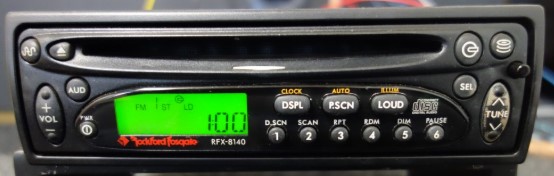
Another important part of the EPX2 system was the RDAT (Remote Data Access Terminal).
Today, we use laptops, tablets, or smartphones to configure a DSP.
That was obviously not the case in the 1990s.
The EPX2 used a dedicated controller that allowed the user to access and adjust the processor’s various functions.
By today’s standards, the interface may look dated, but the concept was remarkably advanced for a car audio processor of the mid-1990s.
The idea of controlling a digital processor through a dedicated remote interface was still relatively new in car audio.
44.1 kHz Digital Processing
The digital architecture of the EPX2 is also particularly interesting.
The EPX2 DSP operated at a 44.1 kHz sampling rate and used a 1-bit Sigma-Delta ADC along with an 18-bit DAC.
Compared with modern DSP specifications, these numbers may not sound particularly impressive today.
But the important point is that this was a car audio processor from the mid-1990s.
It was bringing digital signal processing into the automobile at a time when analog processing was still dominant.
Why Was the EPX2 Special?
The real significance of the EPX2 goes beyond simply being an “old DSP.”
During the transition from analog to digital car audio, Rockford Fosgate used the EPX2 to demonstrate what a future car audio processor could become.
Many concepts that are now common in modern DSP systems were already being applied:
- Digital crossovers
- Multi-channel signal processing
- Digital equalization
- Dedicated controllers for processor configuration
The EPX2 brought these ideas into car audio during the 1990s, long before DSP technology became commonplace.
Why Is It Still Remembered?
If you compare the EPX2 directly with a modern DSP, there is no question that today’s processors offer far more functionality.
Modern DSPs provide sophisticated time alignment, multiple filter types, detailed phase control, PC software, networking, and many other features that were impossible or impractical at the time.
But it would be a mistake to judge the EPX2 simply as an outdated piece of equipment.
The EPX2 was one of the products that demonstrated the potential of digital processing in car audio long before modern DSPs became standard equipment.
Imagine installing and tuning a system like this in a car during the 1990s.
At the time, it must have been an extraordinary experience.
K Sound Gear
At K Sound Gear, we don’t want to talk only about the latest equipment.
We also want to document how modern car audio technology evolved and introduce the products that were ahead of their time.
The Rockford Fosgate Symmetry EPX2 is one of those products worth remembering.
The DSP systems we use today did not appear overnight.
They evolved from products like the EPX2, which pushed the technological boundaries of their era and pointed car audio toward a digital future.
Digital car audio in the 1990s.
And at the center of that story was the Rockford Fosgate Symmetry EPX2.
At K Sound Gear, we’ll continue exploring these hidden legends of car audio, one product at a time.