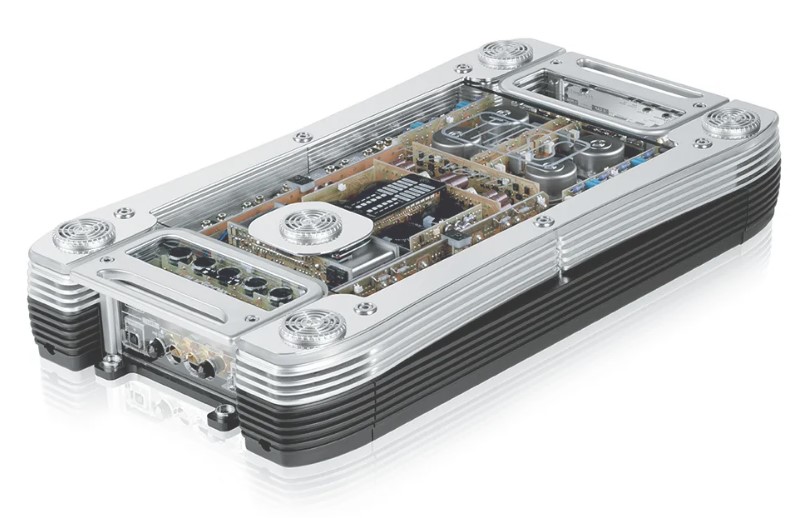
Audison Thesis HV Venti – The Amplifier
The Amplifier Beyond Compromise
There are countless amplifiers in the history of car audio.
Some were designed to deliver more power. Others focused on compact dimensions and high efficiency. Some prioritized installation convenience, while others attempted to incorporate as much of the latest technology as possible.
But a very small number of amplifiers represent something fundamentally different.
They were not created simply to add another product to a manufacturer’s lineup.
They were created because the engineers wanted to answer a much more ambitious question:
What would happen if we built the amplifier we truly wanted to build, without compromise?
The Audison Thesis HV Venti is one of those rare products.
Audison itself gave the amplifier an unusually confident description:
“The Amplifier.”
That statement might sound like typical high-end marketing.
But when you look at the HV Venti’s architecture, power supply, output stage, thermal design, and the philosophy behind its development, the name begins to make considerably more sense.
The important thing about the HV Venti is not simply that it can produce 800 watts × 2.
The more interesting question is:
How far was Audison willing to go to create what it believed could be an ultimate analog car audio amplifier?
And that is where the story of the HV Venti becomes fascinating.
The Story Behind the Thesis HV Venti
To understand the HV Venti, it is important to understand where Audison came from.
The company had already established a reputation for building sophisticated analog amplifiers before the Thesis project appeared.
The HR 100 became one of the company’s most important high-end products, and Audison continued developing its philosophy through amplifiers such as the HV Sedici and HV Trenta.
The objective was not simply to increase power.
Audison was progressively exploring how power delivery, circuit topology, noise control, channel separation, and musicality could be combined into a high-end mobile amplifier.
Eventually, the engineers faced a much bigger challenge.
Could the musicality and refinement associated with the HR 100 be combined with the technological development and power capability of the Thesis platform?
According to Audison’s own description, the HV Venti was the result of approximately two years of research and development.
The result was not simply another powerful amplifier.
It was intended to become a reference product.
Audison later described the Thesis project as a design philosophy based on an “absolute lack of compromise”, and the current official product documentation still presents the HV Venti as the pinnacle of that approach. (오디슨)
“The Amplifier”
The phrase “The Amplifier” is interesting because it tells us something about how Audison positioned the HV Venti.
It was not designed to be the most convenient amplifier.
It was not designed to be the smallest.
It was not designed around digital integration.
It does not even have a digital input.
It is a two-channel analog amplifier.
Yet Audison built it with an extremely sophisticated architecture involving four Synchro-PWM power supplies, a fully balanced signal path, discrete circuitry, relay-based signal switching, a dedicated power-supply board, and a hybrid MOSFET-BJT output stage. (오디슨)
That tells us something important.
The HV Venti was not designed around the question:
“How can we make the most practical amplifier?”
It was designed around a very different question:
“How can we remove as many compromises as possible from the amplification stage?”
The No-Compromise Philosophy
One of the most interesting aspects of the HV Venti is that Audison did not simply select expensive components and call it a high-end amplifier.
The entire architecture was reconsidered.
Audison avoided conventional integrated operational circuitry in critical sections and used discrete devices instead.
Signal switching was handled through specialized relays.
The input section remained balanced through the front-end stages.
High-current paths were kept away from the main signal board in order to reduce electromagnetic interference.
Even the power supplies were physically separated from the main circuit architecture. (오디슨)
This is important because high-end amplifier design is not simply about the quality of individual components.
A very expensive capacitor cannot compensate for a poorly considered signal path.
A powerful transformer cannot automatically guarantee good channel separation.
And a large heatsink does not, by itself, create a better amplifier.
The HV Venti is interesting because Audison approached the amplifier as a complete electrical and mechanical system.
A True Dual-Mono Architecture
The HV Venti is a genuine Dual Mono design.
Audison uses four Synchro-PWM power supply circuits, with the power architecture dedicated to the two amplifier channels.
The power supplies operate in synchronized pairs, with each pair providing the positive and negative rails for a channel.
The purpose is not simply visual symmetry.
It is intended to provide rapid transient current response while reducing unwanted interaction and electromagnetic interference.
Audison also designed the power supply layout so that high-current paths would not run through the main signal board. (오디슨)
This is one of those details that is easy to overlook when reading a specification sheet.
A specification sheet might simply say:
2 channels.
But the actual engineering story is much more complicated.
The amplifier was designed so that each channel could behave much more like an independent high-end amplifier.
That is one of the reasons the HV Venti is fundamentally different from many conventional two-channel car amplifiers.
The Output Stage: Not a Conventional Power Transistor Array
The output stage is perhaps one of the most interesting parts of the HV Venti.
Audison describes it as a unique hybrid topology using discrete devices.
The design combines Hitachi DMOS drivers with Sanken power BJTs, with the output devices rated for substantial current and power dissipation.
The architecture was specifically designed to allow a high bias current to be maintained at the output devices.
This is one of the key elements behind the amplifier’s Class A operation. (오디슨)
And this is where the HV Venti becomes particularly unusual.
Instead of simply paralleling a large number of output devices, Audison designed the output stage so that a relatively small number of powerful devices could operate at a higher bias level.
That allowed the amplifier to push the output stage further into Class A operation without allowing the idle current to become completely impractical.
It is an elegant example of engineering around a difficult constraint.
Why Class A in a Car?
This is perhaps the biggest question.
Why would anyone deliberately choose a Class A approach in a vehicle?
Class A has obvious disadvantages.
It generates heat.
It consumes power.
It requires substantial thermal management.
And automotive electrical systems are not exactly ideal environments for wasting electrical energy as heat.
Yet Audison deliberately accepted those disadvantages.
The HV Venti’s preamplifier, intermediate stages, and drivers are designed around Class A operation, while the output stage bias can be adjusted according to the amplifier’s operating configuration. (오디슨)
This is an important distinction.
The goal was not to make the amplifier efficient.
The goal was to preserve the characteristics Audison considered desirable in a high-end analog amplifier.
In other words:
Efficiency was not the primary design objective.
That sounds almost strange in 2026.
But that is precisely why the HV Venti is interesting.
Dual Power – Hi Power vs. Hi Current
The HV Venti also introduced a particularly unusual feature called Dual Power.
The amplifier can be configured for two different operating philosophies:
Hi Power
or
Hi Current.
The purpose is to allow the amplifier to better match the electrical requirements of the connected loudspeaker.
In the current official specification, Audison lists:
- 400W × 2 @ 4Ω
- 800W × 2 @ 2Ω
- 900W × 1 @ 4Ω
- 1600W total RMS power
- 2-channel Class A operation
- 100A fuse requirement. (오디슨)
Older technical documentation also explains the different load capabilities of the Hi Current and Hi Power configurations.
That distinction is important because it shows that Dual Power was not simply a marketing switch for “more watts.”
It changes how the amplifier behaves electrically.
The Hi Current configuration was intended for difficult, low-impedance loads, while Hi Power was intended to prioritize higher output power into more conventional loads. (ManualZilla)
For a high-end system designer, that is much more interesting than simply having a larger number on the specification sheet.
A 15 kg Two-Channel Amplifier
Then there is the physical reality of the HV Venti.
It measures approximately:
510 × 85 × 280 mm
and weighs:
15 kg.
The official specification also lists an idle current of 4.2 A and a maximum musical-power consumption of approximately 90 A at 14.4 V into 2 ohms. (오디슨)
By modern standards, those numbers are extraordinary.
Today, a compact Class D amplifier can provide enormous power while weighing only a fraction of the HV Venti.
So why carry around a 15 kg amplifier?
Because the weight is not an accidental characteristic.
It is the physical result of the engineering philosophy.
Large power supplies.
Separate power architecture.
Class A circuitry.
Substantial thermal management.
Heavy aluminum construction.
And a mechanical structure designed around the amplifier rather than around minimum size.
The HV Venti represents almost the opposite philosophy of modern ultra-compact amplification.
Modern design often asks:
“How small can we make it?”
The HV Venti asks:
“What does the circuit need?”
And then Audison built around that answer.
The Thermal System Is Part of the Design
The size of the HV Venti becomes even more understandable when you look at its thermal architecture.
The amplifier uses substantial aluminum construction and dedicated cooling paths.
The thermal system is not an afterthought.
It is part of the amplifier’s overall design.
That matters because Class A operation means that heat is generated even when the music is not demanding maximum output.
Audison therefore had to design the amplifier around the thermal consequences of its own electrical philosophy.
This is one of the reasons I would not recommend treating the HV Venti as simply another old amplifier.
When installing one today, ventilation and mounting location are part of the performance equation.
The Crossover Is Also Interesting
There is another detail that modern DSP users may find surprising.
The HV Venti does not have a modern continuously adjustable electronic crossover.
Instead, Audison supplied a dedicated crossover module with selectable frequencies.
The available stereo high-pass/low-pass frequencies are:
45 / 55 / 65 / 80 Hz
with 12 dB/octave filtering, while the mono low-pass section uses 24 dB/octave filtering. (오디슨)
At first glance, this looks primitive compared with a modern DSP.
And technically, it is.
A modern DSP can provide almost unlimited crossover flexibility, time alignment, EQ, phase adjustment, and routing.
But there is an interesting engineering trade-off here.
Audison deliberately kept the filter architecture simple and physically separate in order to minimize signal-path length and preserve filter linearity.
That is a completely different design priority.
This is also why the HV Venti makes much more sense in a modern system when paired with a high-quality external DSP.
The DSP can handle the things the HV Venti was never designed to do.
The HV Venti can then concentrate on what it was designed to do:
amplification.
The HV Venti in a 2026 System
This is where I think the HV Venti becomes particularly interesting.
Should you build a completely old-school system around it?
Not necessarily.
In fact, I would argue that a hybrid approach can make more sense.
A modern digital source.
A high-quality DSP.
Precise time alignment.
Modern crossover management.
Modern loudspeakers.
And then:
HV Venti for the front stage.
This allows modern digital technology to handle system integration while the HV Venti remains responsible for the analog amplification stage.
For someone who values digital processing and time alignment but also appreciates classic high-end analog amplification, this combination makes considerably more sense than trying to recreate an entire 1990s system.
That is one of the most interesting ways to use a product like the HV Venti today.
Who Should Actually Buy an HV Venti?
This is where the specifications become less important than the system.
If you want maximum efficiency:
Don’t buy an HV Venti.
A modern Class D amplifier makes much more sense.
If you want the smallest possible installation:
Don’t buy an HV Venti.
There are vastly more practical solutions.
If you need multiple channels:
Don’t buy an HV Venti as your only amplifier.
It is a two-channel design.
If you want a modern all-in-one DSP amplifier:
Don’t buy an HV Venti.
It has no digital input and does not attempt to replace a modern DSP platform.
But if you want:
A high-end two-channel front stage
Now the conversation changes.
If you are building a serious two-way front stage, especially one driven by a high-quality external DSP, the HV Venti becomes a very interesting option.
It is also attractive to enthusiasts who appreciate the engineering and physical construction of classic high-end analog equipment.
And for collectors, the historical importance of the product adds another dimension.
What Makes a Good Used HV Venti?
This is perhaps more important than any specification.
A used HV Venti should not be evaluated simply by asking:
“Does it turn on?”
A 15 kg amplifier with a complex power supply and high-voltage internal circuitry deserves a much more careful inspection.
1. Power Supply Condition
The power supply is one of the most important areas to inspect.
Look for evidence of previous repairs, damaged components, overheating, or amateur modifications.
Because the HV Venti uses multiple independent power-supply sections, a problem in one section should not be dismissed simply because the amplifier still produces sound.
2. Cooling System
Check the fans and airflow paths carefully.
A clean exterior does not necessarily mean a healthy thermal system.
Dust accumulation, damaged fans, blocked airflow, or previous overheating can become serious problems in an amplifier designed around Class A operation.
3. Internal Modifications
This is particularly important in the vintage high-end market.
A modified amplifier is not automatically a bad amplifier.
A professional restoration can actually be extremely valuable.
But unknown modifications are another matter.
For a collector, an untouched example with documented history may be more desirable than an amplifier that has been heavily modified without documentation.
4. Power and Ground Connections
The HV Venti is not an amplifier that should be installed with casual wiring.
The official specifications list a 100A fuse and up to approximately 90A of current consumption under the specified maximum musical-power condition. (오디슨)
That means the installation must be treated accordingly.
Power cable size, grounding, battery condition, fuse selection, and connection quality all matter.
A beautiful HV Venti paired with an inadequate electrical system is not a high-end installation.
5. Test It Under Load
A power-on test is not enough.
Ideally, the amplifier should be tested with an appropriate load and allowed to operate long enough to determine whether it remains stable as temperature rises.
This is particularly important for an amplifier with such a complex thermal and power architecture.
Don’t Confuse Rarity With Value
Vintage high-end audio has a tendency to create a simple equation:
Rare = Expensive.
That is not always true.
The HV Venti is undoubtedly a historically significant product.
But the market value of a particular example depends heavily on condition.
A clean, original, fully functional amplifier with good cosmetics and a documented history is one thing.
An amplifier with missing parts, unknown modifications, damaged cooling components, or questionable repairs is something completely different.
For a product like this, condition can matter more than rarity.
This is especially important when buying internationally.
The HV Venti is large and heavy, and shipping a 15 kg high-end amplifier across borders is not cheap.
A bargain purchase price can quickly become less attractive once international shipping, taxes, customs charges, insurance, and potential repair costs are included.
What About the Glass Cover?
The physical design of the HV Venti deserves attention as well.
Audison did not hide the engineering completely.
The amplifier uses a tempered glass cover and internal illumination, allowing the owner to see the hardware inside.
That might sound like a purely cosmetic decision.
I don’t think it is.
The HV Venti was designed during a period when high-end car audio equipment was allowed to become part of the visual identity of a system.
Today, many amplifiers are hidden under seats or inside the trunk.
The HV Venti almost asks to be displayed.
The hardware becomes part of the experience.
That is another reason collectors find products like this interesting.
HV Venti vs. a Modern Class D Amplifier
So, is the HV Venti better?
That is the wrong question.
A modern Class D amplifier will usually win on:
- efficiency
- size
- weight
- thermal performance
- installation flexibility
- multi-channel integration
- DSP integration
- digital connectivity
The HV Venti wins in a different category.
It represents:
- discrete analog engineering
- Dual Mono architecture
- substantial power-supply design
- Class A operation
- extremely elaborate thermal engineering
- physical construction
- historical significance
- collector appeal
These are not directly comparable categories.
A modern Class D amplifier is often the better tool.
The HV Venti is a much more interesting piece of engineering history.
And in the right system, it can still be a serious amplifier rather than merely a collector’s object.
The Real Question: Does It Still Make Sense?
In 2026, the HV Venti does not make sense for everyone.
And that is perfectly fine.
A modern amplifier can be objectively more practical.
It can be lighter.
Smaller.
More efficient.
More powerful per kilogram.
And much easier to integrate.
But high-end audio has never been entirely about practicality.
The appeal of products like the HV Venti comes from the fact that someone once decided that practicality was not the only objective.
Audison could have built something smaller.
They could have used more integrated circuitry.
They could have focused more heavily on efficiency.
They could have simplified the power supply.
Instead, they pursued the opposite direction.
More power supply.
More discrete circuitry.
More thermal engineering.
More physical substance.
More complexity.
That is exactly why the amplifier remains fascinating.
The K Sound Gear Perspective
If we describe the HV Venti simply as:
“An old Audison amplifier capable of 800 watts × 2.”
we have missed the point.
The interesting part is not the number.
The interesting part is how Audison tried to achieve it.
The HV Venti is the result of an engineering philosophy in which the power supply, signal path, output stage, thermal system, mechanical structure, and even the visual presentation were considered parts of the same product.
That philosophy is increasingly rare.
Modern audio engineering has moved toward efficiency, integration, miniaturization, and digital processing.
Those developments are not bad.
They are remarkable.
But they represent a different set of priorities.
The HV Venti comes from another school of thought.
A school in which a two-channel car amplifier could weigh 15 kilograms.
A school in which four power supplies could be dedicated to a Dual Mono architecture.
A school in which Class A operation was considered worth the heat and power consumption.
A school in which a manufacturer would spend years developing a single amplifier simply to see how far its engineers could push the concept.
That is what makes the HV Venti historically important.
Should You Own One in 2026?
If your priority is practicality, probably not.
If your priority is efficiency, definitely not.
If you need eight channels, DSP, digital input, and a compact installation, there are countless better choices.
But if you are building a serious two-channel front stage and want an amplifier that represents one of the most ambitious periods of analog high-end car audio engineering, the HV Venti is still worth considering.
And if you are a collector, the appeal becomes even stronger.
The HV Venti is not simply a product from the past.
It is a physical example of how seriously some manufacturers once approached the idea of high-end mobile audio.
Final Thoughts
The best way to understand the Audison Thesis HV Venti is not to ask whether it is objectively better than a modern amplifier.
Instead, ask a different question:
What did Audison believe a high-end car audio amplifier should be?
The answer was not small.
It was not simple.
It was not efficient.
And it certainly was not inexpensive to engineer.
It was ambitious.
Audison took the experience of its earlier high-end amplifiers and pushed the concept toward an extreme combination of discrete circuitry, balanced signal processing, Dual Mono architecture, multiple power supplies, Class A operation, high-current capability, and serious thermal engineering. (오디슨)
The result was an amplifier that became known simply as:
The Amplifier
And perhaps that is the most interesting thing about the HV Venti.
It does not represent the future of car audio.
It represents a moment in its history when engineers were willing to ask:
“How far can we go if we refuse to compromise?”
In 2026, we have smaller amplifiers.
More efficient amplifiers.
More powerful amplifiers.
Smarter amplifiers.
But very few amplifiers carry the same sense of engineering excess.
The HV Venti does.
And that is why it still matters.
K Sound Gear
Vintage & High-End Car Audio