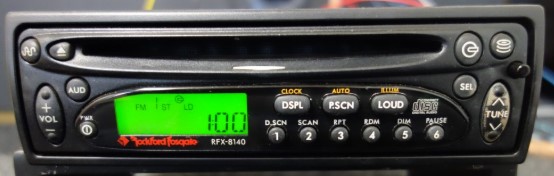
Rockford Fosgate RFX-8140
The 8.5V Competition Head Unit That Ruled the SPL Era
In the late 1990s, car audio was a very different world from what it is today.
Sound quality was important, but so was the ability to build an extremely powerful system and produce massive sound pressure levels. As SPL (Sound Pressure Level) competition continued to grow, the head unit itself became more than just a CD player. It became the heart of a system designed to drive multiple high-powered amplifiers.
One of the most interesting head units from this era was the Rockford Fosgate RFX-8140.
A Head Unit Built for Competition
The RFX-8140 was not simply another premium CD receiver from Rockford Fosgate.
It was positioned as a Competition Source Unit, designed with serious high-output systems in mind.
At the time, SPL systems often used multiple amplifiers rather than a single amplifier. This made the performance of the head unit’s preamp section extremely important.
The RFX-8140 stood out in this area.
The 8.5V Preamp Output
The most famous feature of the RFX-8140 is its 8.5Vrms preamp output.
For a late-1990s head unit, this was an impressive figure.
A high preamp voltage allows the amplifier’s input gain to be set lower while still providing enough signal to reach the amplifier’s full output. This can help improve system noise performance and makes it easier to drive multiple external amplifiers.
Rockford Fosgate clearly designed the RFX-8140 with this philosophy in mind.
It was not simply about making the specification sheet look impressive. The high-voltage output was intended to serve a real purpose in high-output car audio systems.
Low Output Impedance for Multiple Amplifiers
The RFX-8140 also featured a 50-ohm output impedance.
This was particularly useful in systems where one source unit was connected to multiple amplifiers.
A typical installation of the era could look something like this:
RFX-8140 → Multiple Power Amplifiers → Large Subwoofer System
The head unit was designed to provide a strong, stable signal to the amplifiers at the front of the system.
This is one of the key differences between the RFX-8140 and a conventional premium CD receiver.
More Than Just a High-Voltage Source
Despite its competition-oriented design, the RFX-8140 was not simply a loud SPL machine with no concern for sound quality.
Its CD section featured dual 1-bit DACs and 8× oversampling, along with a CD frequency response of 20Hz–20kHz and a signal-to-noise ratio of more than 90dB.
However, the real appeal of the RFX-8140 was the overall concept behind it.
The goal was not merely to play CDs.
The goal was to take the audio signal from the source and deliver it to powerful external amplifiers with as much clean signal voltage as possible.
Rockford Fosgate and the SPL Era
Rockford Fosgate was one of the most influential names in high-output car audio during the 1990s.
As SPL competition became increasingly popular, enormous subwoofers, multiple amplifiers, and high-current electrical systems became common in competition vehicles.
In such systems, the head unit played an important role.
Even the most powerful amplifier could not perform to its potential without a strong signal from the source.
This led many enthusiasts to use dedicated line drivers or high-voltage source units.
The RFX-8140 represented the latter approach.
Instead of relying on a separate line driver, Rockford Fosgate built an extremely high preamp output directly into the head unit.
Why 8.5V Mattered
Today, high-voltage preamp outputs are much more common, especially with modern DSPs and high-end processors.
In the late 1990s, however, 8.5V from a head unit was exceptional.
And the fact that the RFX-8140 was specifically marketed as a Competition source unit makes that number even more significant.
It represented the requirements of the era: powerful source voltage, low output impedance, and the ability to integrate into systems using multiple external amplifiers.
A Symbol of Its Era
By today’s standards, the RFX-8140 is an old CD head unit.
But from a car audio history perspective, it represents something much more important.
It came from an era when car audio was moving beyond simply installing a good stereo system and becoming a serious performance-oriented hobby.
The formula was simple:
Choose a powerful source unit.
Generate a strong preamp signal.
Drive multiple amplifiers.
Build a massive subwoofer system.
And compete for SPL.
The RFX-8140 embodied that philosophy.
Before DSPs became the center of modern car audio systems, a high-end source unit like the RFX-8140 could define the character and capability of an entire installation.
K Sound Gear
The Rockford Fosgate RFX-8140 deserves to be remembered as more than just another vintage CD receiver.
With its 8.5V preamp output, low output impedance, competition-oriented design, and close connection to the high-output SPL culture of the 1990s, it represents one of the most interesting source units from that era.
For today’s enthusiasts, the RFX-8140 is a fascinating reminder of a time when the competition began at the very first stage of the signal chain.
The race for SPL started before the amplifier — it started at the head unit.