Pioneer DEX-P1
A Digital Car Audio Pioneer in the Analog Era
In the late 1990s, the car audio world was still largely analog.
A typical high-end system would take the signal from a head unit, send it through an analog equalizer and crossover, and then use multiple amplifiers to drive the speakers. For serious car audio enthusiasts, installing several pieces of equipment and spending hours tuning them was simply part of the hobby.
Then Pioneer introduced the DEX-P1.
Released in 1998, the DEX-P1 was not simply another high-end CD head unit. Pioneer was trying to change the way a car audio system itself was designed and controlled.
And that change was visible from the moment you looked at the unit.
A Design That Looked Nothing Like Traditional High-End Audio
The DEX-P1 immediately stood apart from many of the high-end head units of its time.
Traditional premium car audio equipment often tried to look like serious audio equipment. Metal front panels, large buttons, rotary controls, and relatively small displays were common. The design itself communicated a sense of luxury and mechanical precision.
The DEX-P1 went in a completely different direction.
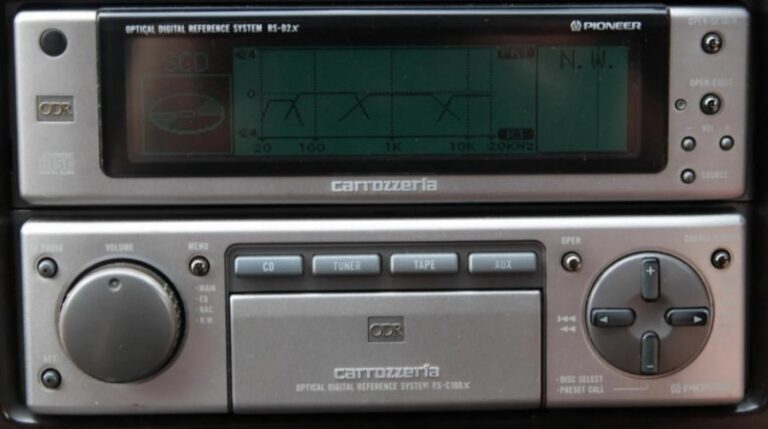
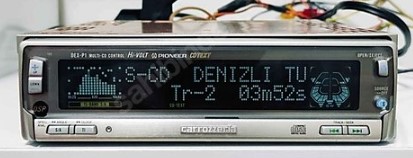
A large portion of its front panel was occupied by a large LCD display, while the number of physical buttons was kept to a minimum.
Instead of looking like a traditional high-end analog audio component, the P1 looked like a piece of advanced digital equipment.
For 1998, it was a remarkably futuristic design.
There was little of the traditional “luxury audio” appearance that people associated with high-end analog equipment. No large control knobs. No oversized collection of buttons.
Instead:
A large display.
A few controls.
And a very digital-looking interface.
It almost seemed as though Pioneer was telling the user:
“This is not just another CD player.”
And it wasn’t.
A Digital Network Inside a 1-DIN Head Unit
The real significance of the DEX-P1 was not its appearance.
It was what Pioneer put inside that 1-DIN chassis.
The P1 incorporated a digital network system, allowing the head unit itself to perform functions that previously required separate processors or analog crossover equipment.
In Standard Mode, the system could be configured for Front / Rear / Subwoofer operation.
But in Pro Mode, things became much more interesting.
The P1 could directly configure a High / Mid / Low 3-way system.
Crossover points, slopes, levels, and phase could be adjusted, while a 13-band graphic equalizer was also built in.
And, remarkably for the time, the P1 also provided time alignment.
Today, these features are completely normal in modern DSP systems.
In 1998, they were anything but normal.
But Many People Didn’t Actually Use It That Way
This is one of the most interesting parts of the P1 story.
Just because a new digital head unit had arrived did not mean everyone suddenly abandoned analog car audio.
In fact, many users were still much more comfortable with the traditional approach.
Analog equalizers.
Analog crossovers.
Amplifier gain controls.
External processors.
And, of course, tuning everything by ear.
That was the world of high-end car audio at the time.
So some people bought a DEX-P1 but continued to build their systems in essentially the same way they always had.
The P1 was used as a high-quality CD source, while an external analog crossover was connected afterward.
There was nothing inherently wrong with that approach.
But there was a problem.
They were not really using the most important feature of the P1.
The digital network capability was largely being bypassed.
And as a result, some users were disappointed.
They may have expected the P1 to completely transform their system, only to find that it did not sound dramatically different from what they were already using.
Looking back, it is actually quite understandable.
The problem was not necessarily the product.
The technology had moved ahead faster than the way people were using car audio.
A New Way of Thinking About Car Audio
Today, using a DSP is completely normal.
We open a computer or smartphone interface, set crossover frequencies, adjust EQ, enter speaker distances, and tune time alignment.
But in the late 1990s, this way of thinking was still relatively unfamiliar.
For someone who had spent years working with analog crossovers and external EQs, suddenly having the head unit control the entire speaker system digitally was a completely different concept.
The DEX-P1 was not simply adding a few new features.
It was proposing a different method of building a car audio system.
That is why the person operating the equipment mattered so much.
Two systems could use the exact same DEX-P1 and still produce very different results.
One person might use it simply as a CD player.
Another might connect an external analog crossover.
Someone else might take full advantage of the P1’s digital network and build a High / Mid / Low system directly from the head unit, using EQ and time alignment to tune the system.
The results could obviously be very different.
A Glimpse of the Future
The DEX-P1 was essentially a transitional product.
It appeared during the period when traditional analog car audio was beginning to move toward digital signal processing.
That makes the P1 particularly interesting today.
Its exterior already reflected the change.
A large digital display.
Minimal physical controls.
And inside, a CD player combined with digital networking, equalization, time alignment, and multi-way system control.
For a product released in 1998, that was an ambitious concept.
The direction Pioneer was taking would continue with later high-end products such as the DEX-P01 and DEQ-P01, which pushed the digital system concept even further.
The DEX-P1 was part of that transition.
Looking Back at the DEX-P1 Today
Compared with a modern DSP, the P1’s capabilities are obviously limited.
Today’s processors offer far more channels, more precise filtering, extensive EQ options, sophisticated delay control, and powerful computer-based tuning software.
But judging the DEX-P1 purely by modern standards misses the point.
What matters is when Pioneer was doing it.
In 1998, when most car audio systems were still built around analog processing, Pioneer was already putting the concept of a digitally controlled multi-way system into a 1-DIN head unit.
That is what makes the DEX-P1 historically interesting.
The Fun of Old-School Car Audio
Looking back, it really was an interesting time.
The technology was beginning to move forward, but many users were still accustomed to the old methods.
The equipment was becoming more sophisticated faster than the tuning culture around it.
Some people used these advanced head units simply as expensive CD players.
Some connected them to external analog crossovers.
And others actually explored the digital network functions and built multi-way systems around them.
The difference between those approaches could be enormous.
That is why the DEX-P1 is more than just an old CD head unit.
It represents a moment when analog car audio was beginning to give way to digital car audio.
In 1998, while most systems were still firmly rooted in the analog world, Pioneer was already showing what the future could look like inside a single 1-DIN chassis.
Perhaps that is also why some people were disappointed with the P1 back in the day.
It wasn’t necessarily that the P1 failed to deliver.
It may simply have arrived before people were ready for it.
A head unit that was already looking toward the future of digital car audio while the rest of the world was still comfortable with analog systems.
That is the Pioneer DEX-P1.
— K Sound Gear