Alpine CDA-7998
When Alpine Brought the F#1 Spirit to a More Accessible High-End System
When looking back at the golden age of Alpine car audio, there are many legendary models that immediately come to mind.
The Alpine CDA-7990, part of the legendary F#1 Status system, represented Alpine’s ultimate pursuit of automotive high-end audio.
But there was another model that I personally remember very fondly.
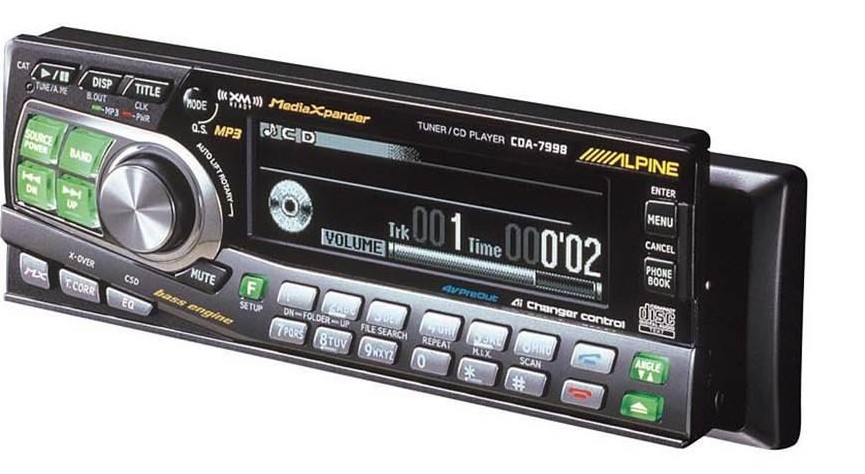
That model is the Alpine CDA-7998.
The CDA-7998 was not the same thing as the F#1 Status system, and it was not intended to replace it.
Instead, it offered something different.
It allowed enthusiasts to experience many of the ideas that were becoming important in Alpine’s high-end digital car audio world, while keeping the system considerably simpler and more accessible.
For me, that was one of the most appealing things about the CDA-7998.
A Unique 1.3-DIN Design
The first thing that made the CDA-7998 stand out was its unusual 1.3-DIN chassis.
At a time when most head units followed the standard 1-DIN format, Alpine took a different approach.
The additional height allowed Alpine to create the distinctive FantomFace XL motorized display.
When the unit was switched on, the display emerged with a very futuristic appearance.
Today, the design obviously looks like a product from another era.
But back then, it was impressive.
The CDA-7998 looked like something that belonged in a high-end system rather than an ordinary car stereo.
More Than Just a CD Player
The CDA-7998 was much more than a CD transport with a display.
It was designed to become the control center of a serious external-amplifier system.
Among its important features were:
- Digital Crossover
- Digital Time Correction
- 5-band Parametric EQ
- 6-channel Digital Time Correction
- 5V preamp outputs
- Optical digital output
- Ai-NET connectivity
- Multi Function operation
- Active 2-way system capability
For the time, this was a very impressive collection of functions.
The CDA-7998 was clearly aimed at enthusiasts who wanted to build a real high-end system rather than simply install a better factory replacement head unit.
Multi Function Made the Difference
One of the most important features of the CDA-7998 was its Multi Function mode.
Once Multi Function was activated, the CDA-7998 could be used as the control center for a more sophisticated multi-amplifier system.
This made it possible to configure an active 2-way front stage, allowing the tweeter and midbass sections to be controlled independently.
That was a big deal at the time.
Today, active 2-way operation is almost taken for granted when using a modern DSP.
Back then, however, having these functions integrated into a premium head unit made the CDA-7998 a very attractive piece of equipment for serious enthusiasts.
The system could be built around external amplifiers, and the CDA-7998 could take care of much of the signal management.
Digital Time Correction
Another feature that made the CDA-7998 special was its Digital Time Correction.
In a car, the driver is sitting much closer to some speakers than others.
The left tweeter, right tweeter, left midbass, and right midbass are all different distances from the listening position.
Without correction, the sound from each speaker reaches the driver’s ears at different times.
The CDA-7998 allowed those differences to be compensated digitally.
With an active 2-way system, this became even more useful because the individual sections of the front stage could be adjusted separately.
The result was a much more controlled soundstage.
Again, this is something we take for granted today.
But at the time, this level of digital control in a head unit was genuinely impressive.
Alpine and the F#1 Status
At the same time, Alpine had an even more ambitious system at the top of its range.
That was the F#1 Status.
The CDA-7990 and PXA-H900 were at the center of this extraordinary system.
F#1 Status represented Alpine’s ultimate pursuit of sound quality.
It was not simply a high-end head unit.
It was a complete philosophy of high-end automotive audio, involving the source, digital processing, amplification, speakers, installation, and tuning.
It was also extremely expensive.
For most enthusiasts, F#1 Status was something to admire rather than something they could realistically build in their own cars.
And this is where the CDA-7998 becomes particularly interesting.
Bringing the F#1 Experience Closer
The CDA-7998 was not an F#1 Status component.
It did not offer the same level of performance or the same system architecture as the CDA-7990 and PXA-H900.
But it allowed enthusiasts to experience many of the ideas that were becoming important in Alpine’s digital high-end systems.
You could build an external-amplifier system around the CDA-7998.
You could activate Multi Function.
You could run an active 2-way front stage.
You could use Digital Crossover.
You could adjust Digital Time Correction.
You could tune the system from the driver’s seat.
That was the attraction.
F#1 Status was the dream.
The CDA-7998 was something you could actually build a system around.
For many enthusiasts, that made the CDA-7998 especially appealing.
The Sound of Alpine
Of course, specifications weren’t the only reason people liked the CDA-7998.
It had that characteristic Alpine approach to sound that many enthusiasts appreciated.
Clean.
Precise.
Open.
Detailed.
With a properly matched amplifier and speaker system, the CDA-7998 could produce a very controlled and refined sound.
And because so much of the system could be adjusted digitally, the final result depended heavily on installation and tuning.
That was an important part of the experience.
The equipment provided the tools.
The installer had to make the system work.
The Fun of Building a System
This is something that is easy to forget when looking at old equipment today.
Back then, building a car audio system was much more hands-on.
You chose the head unit.
You chose the amplifiers.
You chose the speakers.
You decided how to configure the crossover.
You adjusted the time correction.
You listened.
Then you changed it again.
And again.
There was no smartphone app that automatically handled everything.
The system was something you built and tuned yourself.
The CDA-7998 was particularly well suited to this kind of approach.
It gave the enthusiast enough control to build a genuinely sophisticated system without requiring the enormous investment of a full F#1 Status setup.
And Then There Was SPL…
There is also a funny memory associated with the CDA-7998.
In an SPL-oriented car with an extremely powerful subwoofer system, the enormous bass pressure could actually make the graphics on the CDA-7998’s display appear to shake.
The head unit itself wasn’t necessarily moving.
Rather, the intense vibration and pressure inside the vehicle could make the display graphics visibly vibrate.
It was almost as if the display itself was responding to the bass.
Looking back, it’s a funny little detail.
But it also says something about the cars people were building at the time.
Some systems were capable of producing enough low-frequency energy to make even the equipment around them physically react.
That was the world of old-school SPL.
A Different Kind of High-End
The CDA-7998 occupies an interesting position in Alpine’s history.
It wasn’t the ultimate F#1 Status system.
It wasn’t an ordinary Alpine head unit either.
It sat somewhere in between.
It brought advanced digital processing, active crossover control, time correction, and external amplifier integration into a package that was much easier to live with.
That made it possible for more enthusiasts to experience what was happening at the high end of Alpine’s technology.
And that is probably why the CDA-7998 has remained memorable for so many people.
CDA-7998 vs. F#1 Status
Looking back, the difference can be described quite simply.
F#1 Status
The ultimate expression of Alpine’s high-end philosophy.
A complete, uncompromising system designed without ordinary price or complexity limitations.
CDA-7998
A high-end Alpine head unit that brought many of those digital concepts into a much more practical and flexible system.
The two were not competitors in the traditional sense.
They represented different levels of the same era.
F#1 Status showed what Alpine could achieve at the absolute top.
The CDA-7998 showed what an enthusiast could realistically build around a premium Alpine source.
Why I Still Remember the CDA-7998
Looking at it today, the CDA-7998 doesn’t have the conveniences we expect from modern audio equipment.
There is no Bluetooth.
No smartphone streaming.
No USB music library.
It is, fundamentally, a CD-based system.
But that doesn’t really matter.
Because the appeal of the CDA-7998 was never about convenience.
It was about building a system.
It was about choosing the right amplifier.
Finding the right speakers.
Setting the crossover.
Adjusting the time correction.
Listening from the driver’s seat.
And slowly finding the sound you wanted.
That was what made old-school car audio so enjoyable.
Final Thoughts
The Alpine CDA-7998 was one of those products that represented a very interesting moment in car audio history.
The industry was moving from traditional analog systems toward increasingly sophisticated digital processing.
Alpine was developing its ultimate F#1 Status system at the top end, while products like the CDA-7998 brought many of those concepts into a more approachable package.
With its unusual 1.3-DIN design, futuristic FantomFace XL display, Multi Function mode, active 2-way capability, digital crossover, and digital time correction, the CDA-7998 was much more than an attractive CD player.
It was a genuine high-end system controller.
And for enthusiasts who couldn’t realistically build a full F#1 Status system, it offered a way to experience that era of Alpine technology without going quite that far.
That is probably the reason I remember the CDA-7998 so positively.
It wasn’t the most expensive Alpine.
It wasn’t the ultimate Alpine.
But it was one of the most enjoyable Alpines to actually build a system around.
And sometimes, that’s more important.
The F#1 Status was the dream.
The CDA-7998 was the dream you could actually put in your car.
K Sound Gear — Old School Car Audio, Remembered.