Alpine PRA-H400
The Forgotten Beginning of Alpine Digital Car Audio
Before the PXA-H600, before the H700 and H701, and long before modern DSP platforms became standard equipment in high-end car audio, Alpine was already experimenting with digital crossover technology.
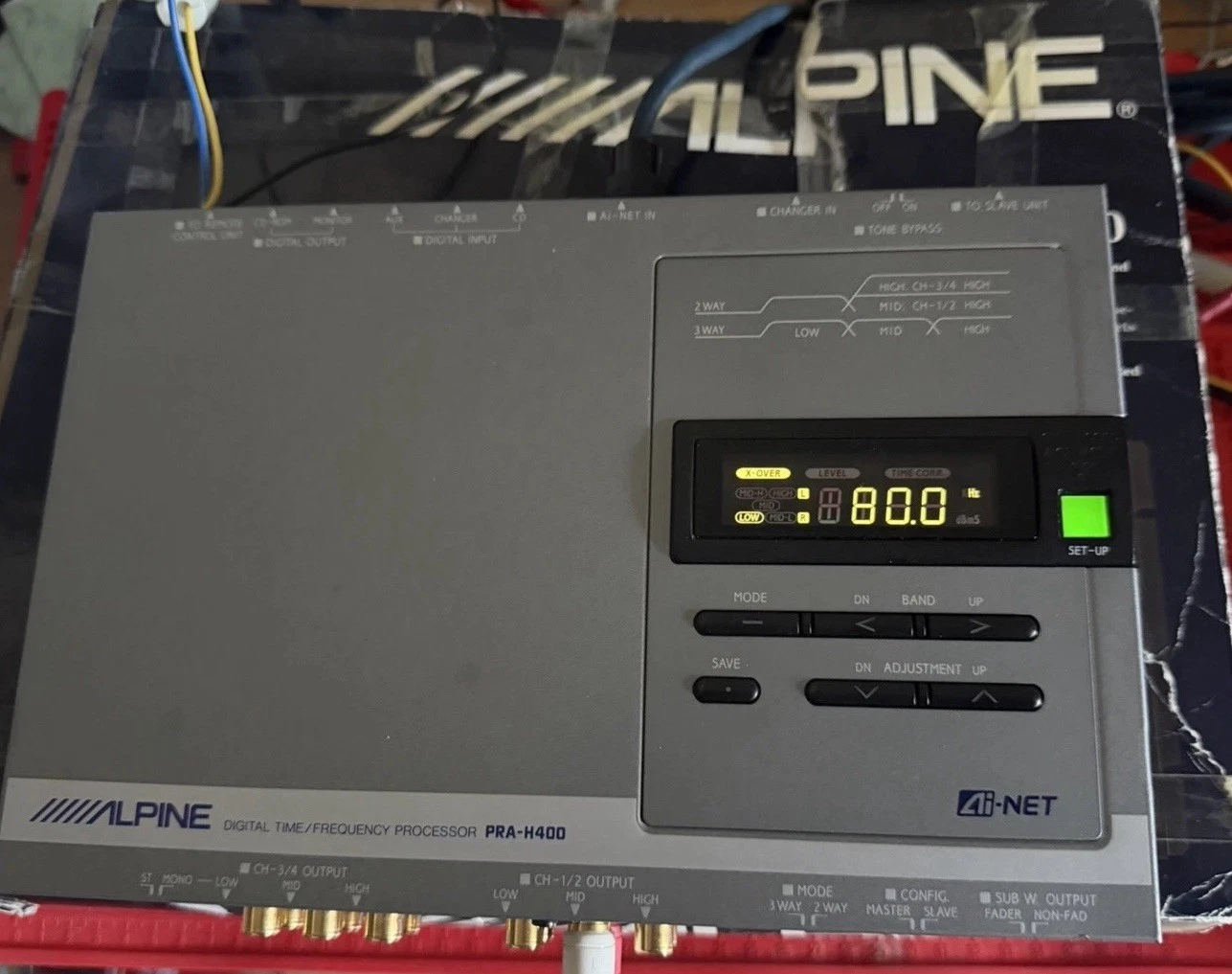
One of the most interesting examples is the Alpine PRA-H400.
Often overlooked today, the PRA-H400 is one of those products that becomes much more impressive when viewed in the context of its time.
It was not designed to be a modern, all-in-one DSP with dozens of EQ bands and computer-based tuning. Instead, Alpine approached the problem from a different direction:
digital crossover + time correction + digital signal processing + high-quality D/A conversion.
The result was an unusually advanced processor for the mid-1990s.
When Was the PRA-H400 Released?
The exact original launch date is surprisingly difficult to document from surviving Alpine records.
However, the PRA-H400 is already documented in Alpine’s 1995 product catalog, where it appears alongside other high-end Alpine components of the period. Period literature also identifies the PRA-H400 as a digital crossover, and by 1996 it was being described as part of Alpine’s flagship system combinations. (Antique Autoradio Madness)
So rather than assigning an unsupported exact month and year, it is more accurate to say:
Alpine PRA-H400 — introduced around 1995 and established as a high-end Alpine component by 1996.
This places the H400 several years before the PXA-H600, which Alpine officially lists as a October 1997 release in Japan. (Alpine Products)
That distinction is important.
The H600 was not the beginning of Alpine’s digital processing story.
The PRA-H400 came first.
What Exactly Is the PRA-H400?
The PRA-H400 is generally described as a Digital Crossover / Channel Divider.
But calling it simply a crossover does not fully explain what it does.
The H400 combines digital crossover processing with:
- Digital time correction
- Output-level adjustment
- Active 2-way or 3-way configuration
- Multiple digital inputs
- Digital signal processing
- D/A conversion
- Memory presets
- Alpine Ai-Net system control
Period specifications list 12 output channels, five inputs, including three optical digital inputs and two analog inputs, as well as digital time correction from 0 to 30 ms in 0.3 ms steps. (온라인카오디오)
That is an extraordinary feature set for a product from the mid-1990s.
A Digital Crossover Before the Modern DSP Era
The biggest difference between the H400 and today’s DSP processors is the philosophy behind the product.
Modern DSPs are usually designed as complete sound-management platforms.
You get:
- Parametric EQ
- Graphic EQ
- Crossovers
- Time alignment
- Phase control
- Routing
- Input summing
- Output mixing
- USB tuning
- Computer software
The PRA-H400 was much more focused.
Its primary job was to provide precise digital crossover control and time correction.
In other words, Alpine was concentrating on getting the signal to the right speaker, at the right frequency, and at the right time.
This makes the H400 particularly interesting from an old-school SQ perspective.
2-Way and 3-Way Configuration
The H400 can be configured for either 2-way or 3-way systems.
A typical 2-way configuration can be understood as:
Front / Rear / Subwoofer
while the 3-way configuration uses:
Front High / Front Mid / Subwoofer
Period Alpine system documentation confirms that one or two PRA-H400 channel dividers could be connected, and Alpine head units could control their crossover settings. (Alpine Europe)
This was particularly useful for enthusiasts building fully active systems.
Instead of relying on passive crossover networks, the H400 could divide the signal electronically before it reached the amplifiers.
For a mid-1990s high-end system, this was serious technology.
12 Output Channels
One of the most impressive specifications of the H400 is its 12 output channels.
That number needs to be understood in the context of how the H400 was designed.
The unit was not simply a 12-channel modern DSP with twelve freely assignable outputs.
Instead, its outputs were organized around Alpine’s 2-way and 3-way active crossover architecture.
This means that the H400 should be thought of as a multi-output digital active crossover, rather than a modern freely routable DSP matrix.
That distinction is important when comparing it with something like a PXA-H701.
Digital Inputs
The H400 was also remarkably advanced in its digital connectivity.
Its specifications list:
5 inputs
including:
- 3 optical digital inputs
- 2 analog inputs
The optical inputs supported 44.1 kHz digital audio. (온라인카오디오)
This is especially interesting because it allowed the H400 to be used as part of a genuinely digital Alpine signal chain.
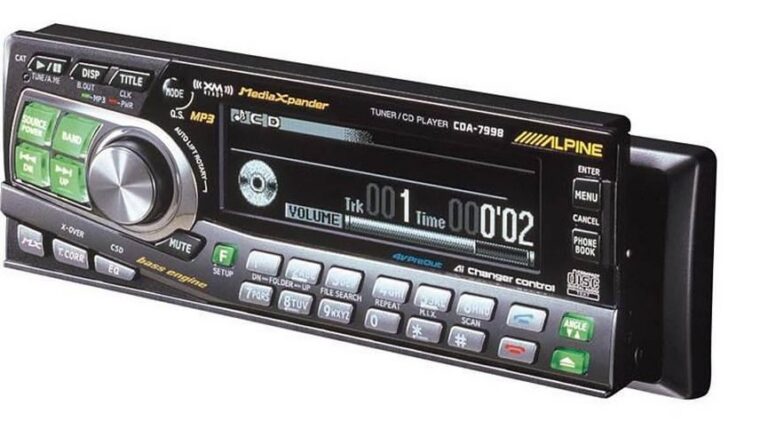
A famous example is the combination of the Alpine CDA-7949 and PRA-H400.
Period enthusiasts have described this combination as a flagship Alpine system, and the CDA-7949/PRA-H400 pairing was particularly attractive because the optical connection allowed the digital signal to reach the H400 directly. (Audioholics Home Theater Forums)
For a system built around CD playback, this was an extremely sophisticated solution for the time.
The DAC Is an Important Part of the Story
The H400 was not merely a digital crossover box.
The signal eventually had to be converted back to analog before being sent to the amplifiers.
The PRA-H400 is specified with an 8× oversampling 18-bit Hybrid I-DAC architecture. (온라인카오디오)
Today, 18-bit may sound unimpressive compared with 24-bit and 32-bit DSP specifications.
But judging the H400 purely by its bit depth would miss the point.
In the mid-1990s, Alpine was designing the H400 as part of a premium digital audio system where the digital processing and analog output stages were both important.
This is also one reason the H400 has developed a reputation among old-school Alpine enthusiasts as a serious-sounding piece of equipment rather than simply an obsolete crossover.
Time Correction
Another major feature is Digital Time Correction.
The H400 provides a correction range of 0–30 ms, adjustable in 0.3 ms steps. (온라인카오디오)
That is essentially the ancestor of what we now call Time Alignment.
The purpose is straightforward.
If the left speaker is closer to the driver than the right speaker, the sound from the left side arrives earlier.
By delaying the appropriate channels, the processor can compensate for those differences and improve the perceived stereo image.
Today this is one of the most basic features of a modern DSP.
In the mid-1990s, however, having digital time correction integrated into a high-end automotive crossover was a very advanced concept.
How Was the H400 Controlled?
This is one area where the H400 is very different from later Alpine processors.
The PRA-H400 was designed to work within the Alpine Ai-Net ecosystem.
Compatible Alpine head units could control functions such as crossover settings and time correction.
For example, Alpine documentation for the CVA-1000E describes the PRA-H400 being controlled from the front-seat display, allowing the user to adjust crossover parameters, time alignment, and subwoofer level without physically going to the processor.
Later Alpine head units also provided processor-related control functions, including preset recall and bass/treble adjustment for the H400. (doczz.net)
This is important when buying a used H400 today.
Unlike the later PXA-H701 + RUX-C701 combination, the H400 was designed around Alpine’s head-unit/display ecosystem rather than a modern-style dedicated DSP controller.
So a complete H400 system is much more interesting when it includes the appropriate Alpine control equipment and cabling.
What Does the PRA-H400 Sound Like?
This is where things become subjective.
There is no single “H400 sound,” because the final result depends heavily on the head unit, digital or analog signal path, amplifiers, speakers, installation, and crossover settings.
However, the architecture of the H400 gives it a very different character from many later Alpine DSPs.
The H400 is fundamentally about:
clarity, timing, separation, and controlled crossover behavior.
It does not have the enormous amount of EQ manipulation available in later processors.
Instead, its strength is the ability to create a clean active system with accurate timing and crossover points.
Old-school Alpine enthusiasts often describe these systems as clean, focused, detailed, and highly coherent, particularly when paired with high-end Alpine source components such as the CDA-7949. These are subjective owner impressions rather than laboratory measurements, but they help explain why the H400 still attracts enthusiasts today. (Audioholics Home Theater Forums)
One particularly interesting aspect is that the H400 can sound very different depending on whether the system uses its optical digital input or analog input.
With a compatible optical source, the signal can remain digital until the H400 performs its processing and D/A conversion.
That was a major part of the appeal of the classic Alpine digital system.
PRA-H400 vs PXA-H600
The H400 and H600 are often confused because they belong to the same general era and both offer digital processing and time correction.
But they are actually quite different products.
| Feature | PRA-H400 | PXA-H600 |
|---|---|---|
| Era | Mid-1990s | 1997 |
| Main purpose | Digital active crossover | Digital sound processor |
| Digital crossover | Yes | No |
| Time correction | Yes | Yes |
| EQ | Very limited / system-dependent | 4-band parametric EQ for front and rear |
| Active 2-way | Yes | Limited by system architecture |
| Active 3-way | Yes | Not its primary purpose |
| Digital inputs | 3 optical | Yes |
| Analog inputs | 2 | Yes |
| Output channels | 12 | Multi-channel front/rear/sub architecture |
| DAC | 18-bit Hybrid I-DAC, 8× oversampling | 20-bit Burr-Brown DAC architecture |
| Control | Alpine head unit / Ai-Net ecosystem | Alpine head unit / Ai-Net ecosystem |
| Main philosophy | Crossover + timing | EQ + timing + sound correction |
The difference can be summarized very simply:
PRA-H400
“Get the signal to the right speaker at the right frequency and at the right time.”
PXA-H600
“Take the system further with digital sound correction and EQ.”
This is why the H400 should not simply be regarded as an inferior H600.
They were designed with different priorities.
The H400 Is Actually More Interesting for Active Systems
There is a fascinating contradiction here.
The H400 is older and technically more limited than the H600 in some areas.
Yet for someone building an old-school active system, the H400 can actually be more interesting.
Why?
Because the H400 provides something the H600 does not emphasize:
digital active crossover processing.
A classic system could be built around:
Alpine CDA-7949
↓
Optical Digital
↓
PRA-H400
↓
Multiple Amplifiers
↓
Active Speakers + Subwoofer
This was a genuinely sophisticated digital car audio system in the mid-1990s.
And it is exactly the kind of system that makes old Alpine equipment fascinating today.
The H400’s Place in Alpine History
The H400 is also important because it changes how we should look at Alpine’s later DSP products.
It is tempting to think:
H600 → H700 → H701 → H800
and treat H600 as the beginning.
But the history is more interesting than that.
The PRA-H400 shows that Alpine was already working seriously on digital crossover and time-correction technology before the H600 appeared.
The H600 then moved Alpine’s digital processing further toward sound correction and EQ.
The H700 and H701 later brought a much more sophisticated multi-channel DSP platform.
And above them came Alpine’s flagship F#1Status processors.
So the H400 is not a footnote.
It is one of the early pieces of the puzzle.
Why the PRA-H400 Still Matters
The PRA-H400 is obviously limited compared with a modern DSP.
It does not have:
- USB tuning
- PC software
- dozens of PEQ filters
- freely assignable DSP routing
- modern high-resolution audio support
- modern measurement systems
But comparing it only by those standards misses the point.
The H400 was developed when these technologies were expensive and difficult to implement.
And yet Alpine managed to put:
digital crossover processing, digital time correction, optical inputs, multi-channel outputs, and high-quality D/A conversion
into a car audio component during the mid-1990s. (온라인카오디오)
That is what makes it special.
Final Thoughts
The Alpine PRA-H400 is one of those products that becomes more impressive the further you look into its history.
It was not the most flexible DSP Alpine ever made.
It was not the most powerful.
And it certainly cannot compete with the processing capabilities of a modern DSP.
But that was never the point.
The H400 represents a period when Alpine was pushing digital technology into high-end car audio and experimenting with ideas that would become fundamental to modern DSP systems.
Digital crossover.
Time correction.
Optical digital audio.
Multi-channel active systems.
High-quality D/A conversion.
All of this was already part of Alpine’s high-end vision in the mid-1990s.
And when paired with legendary Alpine source components such as the CDA-7949, the PRA-H400 formed one of the most interesting digital car audio systems of its generation.
The H600 may be the more recognizable name today.
The H701 may be the more famous old-school Alpine DSP.
But the PRA-H400 came before them — and it deserves to be remembered as one of the early foundations of Alpine’s digital car audio philosophy.
K_sound_gear
Old School Car Audio · DSP · Amplifier · Speaker
Old car audio equipment is more than used equipment.
Every piece has a story — its technology, its sound, and the era in which it was created.
K_sound_gear documents those stories.