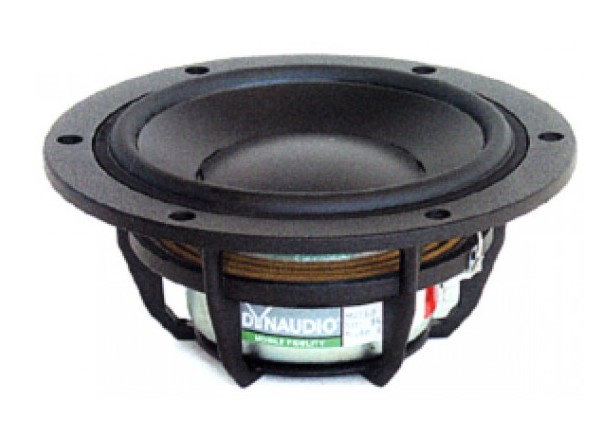
Dynaudio MW160
A High-End Danish Midwoofer That Stands the Test of Time
There are countless car audio speakers on the market.
Every year, new models appear with lighter diaphragms, higher power handling, wider frequency response, and new materials.
Yet some speakers remain highly sought after long after they were introduced.
The Dynaudio MW160 is one of them.
Although it was introduced many years ago, the MW160 is still remembered and sought after by old-school car audio enthusiasts.
Its appeal is not simply that it is an older product.
The MW160 represents something much more interesting: Dynaudio’s high-end home audio engineering adapted to the unique environment of the automobile.
Dynaudio – From Home Hi-Fi to Car Audio
One of the most important things to understand about Dynaudio is where the company came from.
Dynaudio did not begin as a dedicated car audio manufacturer.
The company established its reputation in high-end home loudspeakers, developing its own expertise in critical speaker components such as diaphragms, voice coils, magnets, suspensions, and mechanical structures.
Eventually, Dynaudio brought this accumulated knowledge into the automotive audio market.
In this respect, Dynaudio shares something in common with Focal.
Focal also originated as a French high-end loudspeaker manufacturer before expanding its technology into the automotive market.
This background makes companies such as Dynaudio and Focal particularly interesting in car audio.
Their automotive speakers were not simply designed around the idea of producing loud sound.
They were developed from a high-end loudspeaker engineering philosophy, then adapted to the extremely difficult acoustic environment of a vehicle.
The MW160 is an excellent example of this approach.
A 6.5-Inch Midwoofer With Serious Engineering
At first glance, the MW160 may appear to be simply another 6.5-inch midwoofer.
But a closer look reveals a much more serious design.
The MW160 features a 75 mm large-diameter voice coil, a powerful magnet system, and a robust die-cast frame.
It is rated at 120 watts long-term power handling, with a 4-ohm impedance, and has a recommended frequency range of approximately 40 Hz–4 kHz.
These specifications are not simply about producing high output.
One of the important goals of the MW160 was to achieve a good balance between low-frequency performance and midrange reproduction.
This is particularly important in a two-way system.
A 6.5-inch midwoofer has to cover a surprisingly wide frequency range.
It needs to produce enough energy in the lower frequencies while still reproducing vocals, instruments, and other important midrange information with clarity and natural texture.
That is a difficult balance to achieve.
The Real Strength of the MW160 Is Its Midrange
It would be easy to describe the MW160 simply as a powerful 6.5-inch woofer.
That would miss one of its most important characteristics.
The MW160 was designed with midrange reproduction in mind.
In a two-way car audio system, the midwoofer has a very demanding job.
It must reproduce the lower frequencies while also covering a large portion of the musical midrange before handing over to the tweeter.
Vocals, guitars, piano, strings, and many of the details that make music sound realistic are concentrated in this area.
For that reason, the quality of a midwoofer cannot be judged simply by how much bass it produces.
The MW160 was engineered to provide strong low-frequency performance while maintaining a detailed and natural midrange.
With proper installation and tuning, it can deliver powerful bass while preserving the density, texture, and detail of the midrange.
This is one of the reasons it works particularly well with music where vocal and instrumental texture are important.
Why Is the MW160 Still So Popular?
This is perhaps the most interesting part of the MW160 story.
The MW160 is not a new speaker.
Yet it continues to attract attention among enthusiasts who appreciate classic and old-school car audio.
Why?
One reason is probably its fundamental engineering quality.
Modern speakers use increasingly sophisticated materials and technologies. Diaphragms are lighter, motor structures are more powerful, and manufacturing techniques continue to evolve.
But the basic principles of loudspeaker design have not changed.
How accurately can the motor control the diaphragm?
How smoothly can the speaker reproduce music?
How naturally can it transition into the tweeter?
How well can it balance efficiency, power handling, distortion, and tonal character?
A speaker that gets these fundamentals right can remain relevant for decades.
The MW160 is a good example of that philosophy.
Dynaudio Technology in the Automotive Environment
Home audio and car audio are completely different environments.
In a home listening room, speakers can be positioned symmetrically and the acoustic environment can be controlled to some extent.
A car is the opposite.
The speakers are usually mounted inside doors or other limited locations, while glass, dashboards, seats, trim panels, and other surfaces all affect the sound.
The driver and passenger also sit at very different distances from the left and right speakers.
For this reason, automotive speakers cannot simply be treated as home audio drivers installed inside a vehicle.
They need to work within the limitations of the automotive environment.
Dynaudio had to adapt its loudspeaker engineering philosophy to these conditions, and the MW160 represents that approach.
It combines the company’s experience in high-end loudspeaker design with the requirements of automotive installation.
The MW160 Meets Modern DSP Technology
One particularly interesting aspect of a classic driver like the MW160 is how well it can work with a modern DSP-based system.
In the past, installers relied heavily on analog crossovers, amplifier gain adjustments, polarity changes, and physical installation techniques to tune a system.
Today, DSP technology allows much more precise control.
Crossover frequencies and slopes can be adjusted digitally.
Individual channel levels can be precisely matched.
Time alignment can compensate for the different distances between the speakers and the driver’s ears.
EQ can be used to correct the response of the speaker and the vehicle’s acoustic environment.
In other words, the MW160 may be an old-school driver, but the way we can use and tune it today is anything but old-school.
This combination of classic hardware and modern digital processing is one of the reasons vintage high-end car audio equipment remains so interesting.
More Than Just a Vintage Speaker
The vintage car audio market is full of products that were expensive and impressive when new but have largely disappeared from enthusiasts’ attention.
Then there are products that gain a different kind of value over time.
The Dynaudio MW160 belongs to the latter group.
Its value does not come simply from its age.
It comes from the engineering behind it.
A large voice coil, strong motor structure, robust mechanical construction, and a design focused on both low-frequency authority and midrange quality make the MW160 more than just an old 6.5-inch speaker.
It represents an important period in the development of high-end automotive audio.
And that is why it continues to have a special place among old-school car audio enthusiasts.
When Good Engineering Stands the Test of Time
Car audio technology has changed dramatically.
DSP systems have become more sophisticated.
Amplifiers have become smaller and more efficient.
Digital signal processing has become a fundamental part of modern system design.
But the arrival of new technology does not automatically make every older speaker obsolete.
In fact, modern technology can sometimes make classic speakers even more useful.
A high-quality vintage driver can be combined with modern DSP technology to achieve a level of tuning precision that was simply not available when the speaker was originally released.
The Dynaudio MW160 is a perfect example.
It may be an old-school driver, but it does not have to produce an old-school system.
Good engineering can survive changes in technology.
And the fact that enthusiasts continue to search for and appreciate the MW160 years after its introduction is a testament to the quality of its original design.
Dynaudio MW160
The MW160 represents a fascinating chapter in car audio history.
It is a product from a time when a high-end home loudspeaker manufacturer brought its engineering philosophy into the automotive world.
A 6.5-inch Danish midwoofer, designed to deliver both strong low-frequency performance and detailed midrange reproduction.
And perhaps most importantly, it is a speaker that still makes sense today.
Because while technology changes, the fundamentals of good loudspeaker design do not.
Dynaudio MW160.
A classic Dynaudio automotive driver that continues to demonstrate why well-engineered loudspeakers can remain relevant long after their introduction.
K Sound Gear