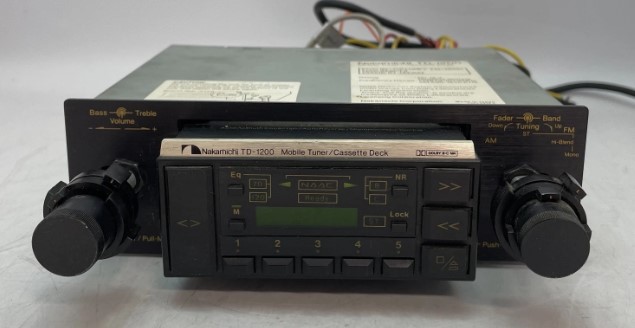
Nakamichi TD-1200
The Beginning of High-End Mobile Audio
There was a time when building a serious car audio system started with one simple principle:
The source comes first.
Long before digital DSP, streaming, wireless audio, and computer-controlled sound processing became part of everyday car audio, serious enthusiasts paid enormous attention to the component that actually reproduced the music.
In the early 1980s, one company took this philosophy further than almost anyone else.
Nakamichi.
And one of the products that best represented this philosophy was the Nakamichi TD-1200.
It wasn’t simply an expensive car stereo.
It was Nakamichi’s attempt to bring the standards of high-end home audio into the automobile.
When Nakamichi Entered the Car
Nakamichi had already established an extraordinary reputation in home audio.
The company was known for precision cassette transports, advanced recording and playback heads, sophisticated electronics, and an almost obsessive approach to analog reproduction.
Then Nakamichi turned its attention toward the automobile.
The question was simple:
Why should a car be considered an inferior listening environment?
The TD-1200 was part of Nakamichi’s answer.
Introduced in the early 1980s, the TD-1200 was positioned as a high-end mobile tuner/cassette deck rather than an ordinary car stereo.
It was designed to become the source component at the heart of a serious mobile audio system.
At a time when most automotive head units were built primarily around convenience and affordability, Nakamichi was pursuing something very different.
Sound quality.
A Car Stereo That Wasn’t Just a Car Stereo
The TD-1200 was an extraordinarily ambitious product for its time.
Its original retail price was around $1,300, placing it firmly in the luxury end of the car audio market.
That was an enormous amount of money for a mobile source in the early 1980s.
But Nakamichi wasn’t simply selling a cassette player.
The TD-1200 combined a precision cassette transport, a sophisticated AM/FM tuner, and a carefully designed analog signal path.
Every part had a purpose.
The goal wasn’t to offer the largest number of features.
The goal was to make the important parts work exceptionally well.
This was a very different way of thinking about car audio.
The Technology Behind the TD-1200
The TD-1200 incorporated technology that was extremely advanced for a mobile audio product of its era.
Its features included:
- Dual-capstan cassette transport
- Direct-drive capstan
- Auto-reverse
- Dolby B and Dolby C noise reduction
- Metal tape compatibility
- AM/FM tuner
- Quartz-PLL synthesized tuning
- Approximately 20Hz–22kHz frequency response with Metal tape
- Approximately 0.045% wow and flutter
- Approximately 70dB signal-to-noise ratio with Dolby C
- Approximately 1.1V line output
But one feature in particular made the TD-1200 stand apart.
NAAC.
NAAC — Nakamichi Automatic Azimuth Correction
To understand the TD-1200, you have to understand azimuth.
A cassette tape stores extremely small magnetic signals.
For the playback head to reproduce those signals correctly, the head must be precisely aligned with the recording.
Even a small azimuth error can affect high-frequency response and stereo separation.
This was one of the fundamental problems of cassette reproduction.
A tape recorded on one machine might not be perfectly aligned when played on another.
For an ordinary cassette player, this might not matter much.
For Nakamichi, it was unacceptable.
The company developed NAAC — Nakamichi Automatic Azimuth Correction.
The system automatically adjusts the playback head’s azimuth to match the tape being played.
This technology had already become famous through Nakamichi’s high-end home cassette decks.
Bringing it into a mobile cassette deck was a remarkable achievement.
The TD-1200 wasn’t simply playing the tape.
It was actively trying to extract as much information from that tape as possible.
That is a very Nakamichi approach to engineering.
A Precision Cassette Transport
Nakamichi also paid enormous attention to the transport mechanism.
The TD-1200 used a dual-capstan transport with direct-drive technology.
The objective was straightforward:
Control the tape as accurately as possible.
Tape-speed stability is critical to cassette reproduction.
Any instability can become audible as pitch variation, loss of focus, and reduced musical precision.
With approximately 0.045% wow and flutter, the TD-1200 achieved a level of mechanical precision that was remarkable for a mobile cassette deck of its era.
This was not the kind of mechanism designed simply to play a cassette reliably.
It was designed to reproduce the information stored on the tape with as little mechanical error as possible.
Nakamichi was effectively bringing the engineering philosophy of a high-end home cassette deck into the much more difficult environment of a moving automobile.
The Tuner Was Serious, Too
The TD-1200 was not only a cassette deck.
It was also a sophisticated mobile tuner.
The tuner section used quartz-PLL synthesized tuning and preset stations, while its design took into consideration the difficult reception environment inside a moving vehicle.
This was important because Nakamichi treated every source as part of the high-fidelity experience.
Cassette playback.
FM.
AM.
Every signal entering the system deserved the same level of attention.
The TD-1200 was therefore much more than a cassette mechanism with a radio attached.
It was designed as a complete high-end mobile front end.
The Analog Character
But specifications alone don’t explain why the TD-1200 remains interesting today.
The real fascination is its analog character.
There is something different about a carefully engineered analog source.
The presentation can feel smooth.
Natural.
Organic.
Musical.
Vocals can have a particular texture.
Acoustic instruments can retain a sense of body.
And the overall presentation can feel very different from the clinical precision sometimes associated with early digital sources.
This is part of the reason Nakamichi became such an important name among analog enthusiasts.
The TD-1200 belongs firmly to that era.
An era when the source itself was considered an essential part of the sound.
More Than a Head Unit
For serious car audio enthusiasts, the TD-1200 wasn’t simply a device for playing cassettes.
It could become the heart of the entire system.
During the golden age of analog car audio, enthusiasts carefully selected every component.
The source.
The amplifier.
The speakers.
The crossover.
The installation.
The tuning.
The head unit wasn’t expected simply to provide a signal.
It was expected to become part of the system’s character.
This is where the TD-1200 became especially attractive.
Its sophisticated analog output and high-quality cassette reproduction made it a natural choice for enthusiasts who wanted a refined musical front end.
In serious systems of the era, the source could be treated almost like a high-end preamplifier in a home audio system.
The goal was not simply to make sound.
It was to create a musical signal path from the very beginning.
Before Digital, the Source Mattered
Today, DSP technology gives us an incredible amount of control.
We can adjust frequency response.
We can set precise time alignment.
We can control crossover points and slopes.
We can manipulate phase.
We can build extremely sophisticated active systems.
But the TD-1200 came from a completely different world.
There was no computer software.
No smartphone app.
No digital room correction.
No streaming.
The source was physical.
The tape was physical.
The signal path was analog.
And the quality of every component mattered.
This created a very different kind of car audio culture.
The enthusiast didn’t simply configure a system.
They built one.
Why Nakamichi Went This Far
The TD-1200 makes sense when you understand Nakamichi’s philosophy.
The company had spent years refining cassette technology in the home audio market.
Nakamichi understood that a cassette could be far more than a casual recording medium.
With the right transport, head alignment, tape control, and electronics, cassette could become a genuine high-fidelity source.
The TD-1200 brought that philosophy into the automobile.
That was the revolutionary part.
Nakamichi wasn’t asking:
“How good can we make a car stereo for the money?”
It was asking something much more ambitious:
“How good can a car audio system actually sound?”
The Evolution of a Legend
The original TD-1200 was only the beginning.
Nakamichi continued to develop the concept through several generations of high-end mobile cassette decks.
The next major step was the TD-1200II, followed in 1989 by the TD-1200 Limited.
Then, in 1990, came the TD-1200SE, which would become one of the most recognizable and desirable Nakamichi mobile head units among enthusiasts and collectors.
The basic lineage can therefore be remembered as:
TD-1200 → TD-1200II → TD-1200 Limited → TD-1200SE
Each generation refined Nakamichi’s approach to high-end mobile cassette reproduction while maintaining the fundamental philosophy established by the original TD-1200.
The later models deserve their own stories, so we will explore them separately.
For now, the important point is where the story began.
The original TD-1200.
Why the TD-1200 Still Matters
Modern technology has made car audio more convenient and more powerful than ever.
We can carry thousands of songs in a device smaller than a cassette case.
We can stream almost anything instantly.
We can control a complete DSP system from a laptop or smartphone.
From a technological perspective, modern equipment is obviously far more advanced.
So why does the TD-1200 still matter?
Because it represents something that has gradually disappeared from modern car audio:
The belief that the source itself should have character.
The TD-1200 wasn’t designed to be cheap.
It wasn’t designed primarily for convenience.
It wasn’t designed simply to offer the most features.
It was designed to reproduce music.
And Nakamichi was willing to spend the money, engineering effort, and complexity required to achieve that goal.
A Different Kind of Luxury
The TD-1200 was expensive.
It required serious components around it.
It demanded careful installation.
And it belonged in a system where the owner cared about every part of the signal chain.
That was part of the experience.
Owning a TD-1200 wasn’t simply owning an expensive head unit.
It meant choosing a philosophy.
Source first.
Signal quality first.
Music first.
That philosophy may seem old-fashioned today.
But for anyone who truly cares about sound quality, it still makes perfect sense.
The Soul of Analog Car Audio
There are products that are technologically impressive.
And then there are products that have a certain soul.
The TD-1200 belongs in the second category.
Its technology is fascinating.
Its engineering is impressive.
Its historical importance is undeniable.
But what keeps people interested decades later is the feeling that this machine was built by people who genuinely cared about music.
That is something a specification sheet cannot measure.
And perhaps that is the greatest appeal of classic Nakamichi equipment.
K Sound Gear
At K Sound Gear, we don’t want to remember classic car audio simply as old equipment.
We want to remember why it mattered.
The Nakamichi TD-1200 is a perfect example.
It came from a time when engineers believed that a car could become a serious listening environment.
A time when analog technology was refined to an extraordinary level.
A time when a cassette tape could be treated as a genuine high-fidelity source.
And a time when the head unit wasn’t simply a control panel.
It was the heart of the system.
The TD-1200 represents the beginning of that philosophy in Nakamichi’s mobile audio history.
Before DSP.
Before streaming.
Before digital convenience.
There was the tape.
There was the machine.
And there was the pursuit of better sound.
Nakamichi TD-1200.
The Beginning of a Legend.
K Sound Gear
Classic Car Audio · Sound Quality · The Stories Behind the Gear