DENON DCT-1
The Final Statement of DENON’s High-End Car Audio
There are many vintage car audio head units that are remembered because they were popular.
And then there are products that are remembered because they represented the absolute limit of what their manufacturer wanted to achieve.
The DENON DCT-1 belongs to the second category.
For K Sound Gear, the DCT-1 is particularly interesting because it represents a completely different approach from many of the American old-school amplifiers and processors of the same era.
This was not simply a car stereo with a CD player.
DENON approached car audio much more like a high-end home audio component.
And the DCT-1 was arguably the ultimate expression of that philosophy.
DENON and the World of Car Audio
DENON is a name that has long been associated with high-fidelity audio.
The company has a long history in home audio, professional audio, and digital audio technology, so when DENON entered the car audio market, it brought a very different philosophy with it.
According to DENON’s own retrospective, the company began its car audio business in North America in 1985.
The Japanese market later received DENON’s car audio products, with models such as the DCT-950R appearing in 1995.
DENON’s car audio lineup continued to develop through a series of increasingly sophisticated models, eventually reaching the DCT-Z1, DCT-A1, and DCT-1.
The company eventually left the car audio business after releasing its final model in 2004.
That makes the DCT-1 particularly significant.
It was not simply another model in a long-running product line.
It appeared near the end of DENON’s car audio history.
A Car Head Unit Designed Like a Hi-Fi Component
One of the most interesting things about DENON’s approach was the philosophy behind the system.
Many car stereos of the period were designed as all-in-one entertainment units.
Radio.
CD.
Amplifier.
Tone controls.
Sometimes additional processing.
DENON took a different approach.
Its high-end models were designed as component-based audio sources, often requiring an external power amplifier.
DENON itself described this philosophy as being very similar to high-end Hi-Fi components.
The head unit was the source.
The amplifier was a separate component.
The listener could choose the amplifier that best suited the system.
This was an important distinction.
The goal was not simply to produce a convenient car stereo.
The goal was to build a serious audio system inside a car.
DCT-1 — The Flagship
Among DENON’s car audio lineup, the DCT-1 occupied the flagship position.
It was a 1DIN CD player designed to work with an external amplifier rather than trying to provide everything in one chassis.
The physical dimensions are a standard 1DIN:
178 × 50 × 163 mm
and the unit weighs approximately 1.7 kg.
Those numbers may not sound particularly impressive today.
But remember what is inside that 1DIN chassis.
A CD transport.
Digital processing.
D/A conversion.
Analog audio circuitry.
Power supply circuitry.
Display and control electronics.
And a sophisticated output stage.
All of this had to fit inside a small space designed for a vehicle dashboard.
The Output Stage Was Serious
One of the reasons the DCT-1 is still interesting to high-end car audio enthusiasts is its output architecture.
The DCT-1 provides a 4V RCA output and a significantly higher 8V balanced output under the specified load conditions.
That is a very different philosophy from a typical consumer head unit.
The idea was to provide a strong, high-quality signal to an external amplifier.
The head unit was not expected to do the job of a power amplifier.
It was supposed to be the source component of the system.
That distinction is important when understanding why the DCT-1 has remained so highly regarded.
Optical Output — A Very Important Feature
Another particularly interesting feature of the DCT-1 is its optical digital output.
The DCT-1 provides a digital audio interface at 44.1 kHz, with an optical output specification listed in its documentation.
This is significant because it gives the DCT-1 another role beyond being simply an analog CD player.
The owner could use the DCT-1 as a digital source and connect it to compatible digital equipment.
That made it possible to integrate the DCT-1 into more sophisticated systems.
For enthusiasts who wanted to build a high-end system around digital processing, this was a very useful feature.
It also demonstrates how DENON was already thinking beyond the traditional “head unit → RCA → amplifier” approach.
The DAC and the Pursuit of Digital Audio
The DCT-1 appeared during an important period in digital audio.
CD was already well established, but high-end manufacturers were still working aggressively to extract better performance from the format.
DENON had extensive experience in digital audio, and that technology was increasingly being incorporated into its car audio products.
The DCT-1 was therefore not designed merely to play CDs.
It was designed to reproduce the information stored on those CDs with as much accuracy and refinement as possible.
This is one of the reasons vintage DENON head units continue to attract attention from enthusiasts who are interested in CD-based systems.
The Sound of the DCT-1
Talking about the sound of a vintage head unit is always subjective.
But the DCT-1 has accumulated an unusually strong reputation among enthusiasts.
Japanese user reviews frequently describe its sound as clean, highly resolved, and free from unnecessary coloration.
One long-term user described the DCT-1 as producing a very clear presentation with little unnecessary resonance and a strong sense of transparency.
Another contemporary discussion compared the DCT-1 with the DCT-A100 and described the DCT-1 as having a smoother and more balanced presentation, with strong resolution and a very good signal-to-noise character.
Of course, these are listening impressions rather than laboratory measurements.
But the consistency of those impressions is interesting.
The DCT-1 was repeatedly associated with a clean, neutral, highly resolved presentation.
The DCT-1 Compared With the DCT-A1 and DCT-Z1
The DCT-1 did not appear out of nowhere.
It came after other important DENON models such as the DCT-A1 and DCT-Z1.
This is part of what makes the DCT-1 interesting.
It can be viewed as the culmination of DENON’s development of high-end car audio source units.
Enthusiast accounts comparing these models often describe differences in tonal balance and presentation.
One Japanese owner who had used the DCT-A1 and DCT-Z1 described the DCT-1 as having a stronger midrange foundation and a particularly faithful expression of the characteristic DENON sound.
Another owner reported that moving from the DCT-A1 to the DCT-1 resulted in a thicker midrange presentation.
These impressions are subjective, but they help explain why collectors are interested in the different models rather than simply treating them as interchangeable DENON CD players.
Why the DCT-1 Needed an External Amplifier
This is another important part of understanding the DCT-1.
Today, many head units contain powerful internal amplifiers.
That was not the point of the DCT-1.
The DCT-1 was designed as the source component.
The external amplifier was a separate piece of the system.
This approach was much closer to home Hi-Fi.
Think about a traditional home audio system.
You might have:
CD Player → Preamp → Power Amplifier → Speakers
The DCT-1 brought part of that philosophy into the car.
The source was treated as a serious component.
The amplifier was selected separately.
And the rest of the system could be built around those choices.
The Era of Dedicated Components
This is perhaps the most important reason the DCT-1 belongs in the history of old-school car audio.
During this era, building a serious car audio system often meant selecting individual components.
A high-end head unit.
A separate EQ or processor.
A dedicated crossover.
One or more power amplifiers.
High-end speakers.
A dedicated subwoofer.
Every component had its own character.
The system was not necessarily easy to install.
It required planning.
It required tuning.
And it required the owner to understand how all of the components interacted.
The DCT-1 was created specifically for that kind of enthusiast.
DCT-1 and the Analog vs. Digital Era
The DCT-1 also represents an interesting point in car audio history.
It belongs to the end of the traditional CD-based analog system era, while simultaneously offering a bridge toward digital systems through its optical output.
That makes it especially interesting in retrospect.
You could build a traditional analog system around the DCT-1.
Or you could take its digital output and integrate it into a more advanced digital system.
In other words, the DCT-1 sat at the intersection of two different generations of car audio.
The old analog world and the emerging digital world.
Why the DCT-1 Became So Rare
DENON eventually withdrew from the car audio market.
As the industry moved toward navigation, multimedia, displays, and integrated AV systems, the market for a dedicated high-end CD player became increasingly limited.
DENON itself explains that the car audio market gradually shifted toward navigation and AV-centered systems, reducing demand for standalone audio components. The company released its final car audio model in 2004 before leaving the market.
That decision had an unintended consequence.
The DCT-1 became one of the final representatives of a philosophy that was disappearing.
A dedicated high-end CD head unit.
No unnecessary multimedia functions.
No giant screen.
No navigation.
No attempt to do everything.
Just a serious source component.
A Product From a Different Philosophy
This is what makes the DCT-1 so fascinating today.
Modern car audio equipment is incredibly capable.
A modern DSP can perform equalization, crossover control, time alignment, phase adjustment, and signal routing with extraordinary precision.
Modern source units can stream music, navigate, connect to smartphones, and handle multiple digital formats.
The DCT-1 does none of those things.
It simply plays CDs.
And yet that simplicity is part of its appeal.
The DCT-1 was designed around a very specific goal:
to be an excellent source for a serious car audio system.
The Physical Design
The design also deserves attention.
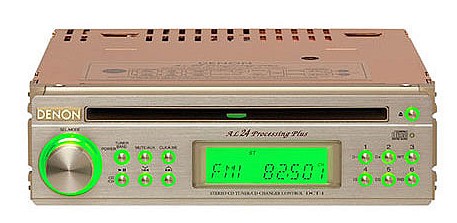
The DCT-1 has a restrained, almost understated appearance.
There is no oversized display.
There is no flashy multimedia interface.
There is no attempt to make the unit look futuristic.
Instead, the design has a distinctly Hi-Fi character.
It looks more like a serious audio component than a conventional car stereo.
That was intentional.
DENON’s car audio products inherited design ideas from the company’s home Hi-Fi products, giving them a visual identity that separated them from many mainstream car stereos of the period.
Why Collectors Still Want One
Today, the DCT-1 is interesting for several reasons.
First, it is one of DENON’s flagship car audio models.
Second, it represents the end of DENON’s involvement in the car audio market.
Third, it has a strong reputation among vintage car audio enthusiasts.
And finally, it is a genuinely unusual product.
There are many old CD head units.
There are far fewer that were designed with this level of attention toward high-end audio and external system integration.
That combination makes the DCT-1 particularly attractive to collectors.
The DCT-1 in a Modern K Sound Gear System
Interestingly, the DCT-1 can still make sense in a modern system.
Imagine a system built around:
DENON DCT-1
→ Digital or analog processing
→ DSP
→ High-quality amplifier
→ Two-way front stage
→ Subwoofer
The DCT-1 could serve as a dedicated CD source while modern DSP technology handles the tuning.
That combination would bring together two very different eras.
The DCT-1 provides the character and physical experience of vintage CD playback.
The DSP provides the flexibility of modern system tuning.
It is a very different approach from using the DCT-1 simply because it is old.
The End of an Era
The DCT-1 is more than a vintage CD player.
It represents a period when manufacturers were willing to build a dedicated high-end car audio source with no need to compete on screen size, smartphone integration, navigation, or multimedia features.
It was a product designed for people who cared about the sound coming from a CD.
That market eventually disappeared.
But the product remains.
And decades later, the DCT-1 has become a reminder of what high-end car audio once looked like.
K Sound Gear’s View
For me, the most interesting thing about the DENON DCT-1 is not simply its specifications.
It is the philosophy behind it.
DENON took the principles of high-end home audio and compressed them into a 1DIN car audio component.
A dedicated CD transport.
Serious digital and analog circuitry.
High-level analog outputs.
Balanced output capability.
Optical digital output.
External amplification.
And a system-oriented design philosophy.
The DCT-1 was never meant to be everything.
It was meant to be one excellent part of a complete system.
And that is perhaps the biggest difference between the DCT-1 and many modern head units.
Today, we often ask one product to do everything.
The DCT-1 asked the opposite question:
What if one component simply did its own job extremely well?
That is why the DENON DCT-1 deserves its place in the history of high-end car audio.
It was one of the final statements from a company that treated the car not simply as a place to install a stereo, but as another environment in which serious Hi-Fi could be pursued.
And perhaps that is why, even after all these years, the DCT-1 still feels special.
**It is not just an old CD player.
It is a piece of the last great era of dedicated high-end car audio.**
K Sound Gear
At K Sound Gear, we believe vintage car audio is more than a collection of old equipment.
Every amplifier, CD player, equalizer, and crossover represents a particular period in the evolution of car audio.
The DENON DCT-1 represents one of the most interesting chapters:
when Japanese Hi-Fi engineering met the world of high-end car audio.
And that is exactly why these machines are still worth remembering.