PPI A600.2 Art Series
A Legend of Old-School American Car Audio
If you have been involved in car audio for any length of time, there is a good chance you have heard the name Precision Power, better known as PPI.
Today, there are countless car audio amplifier manufacturers, but PPI held a very different position in the American car audio scene during the 1990s.
PPI was not simply a company focused on producing high-power amplifiers.
The brand became known for combining sound quality, power-supply design, build quality, and distinctive industrial design into a single product.
At the center of that identity was the legendary Art Series.
And today, K Sound Gear takes a look at one of the best-known amplifiers from that series:
The PPI A600.2.
The Era That Made PPI Special
Modern car audio systems can accomplish an incredible amount with a single DSP.
A digital source can feed a DSP, where the installer can control crossover points, equalization, time alignment, channel levels, and countless other parameters before sending the signal to a multi-channel amplifier.
Car audio in the 1990s was completely different.
A high-end system was rarely built around a single component.
The head unit produced the signal.
An equalizer shaped the frequency response.
A crossover divided the signal between the speakers.
Separate amplifiers powered the different sections of the system.
Additional processors could be added when necessary.
In other words, the system was built by selecting individual components and giving each one a specific job.
PPI was one of the brands that became particularly important during this era.
The Art Series
The appeal of the Art Series was not simply its power output.
PPI approached the amplifier as an important part of the overall car audio system, both sonically and visually.
That philosophy is reflected in the name itself:
Art Series.
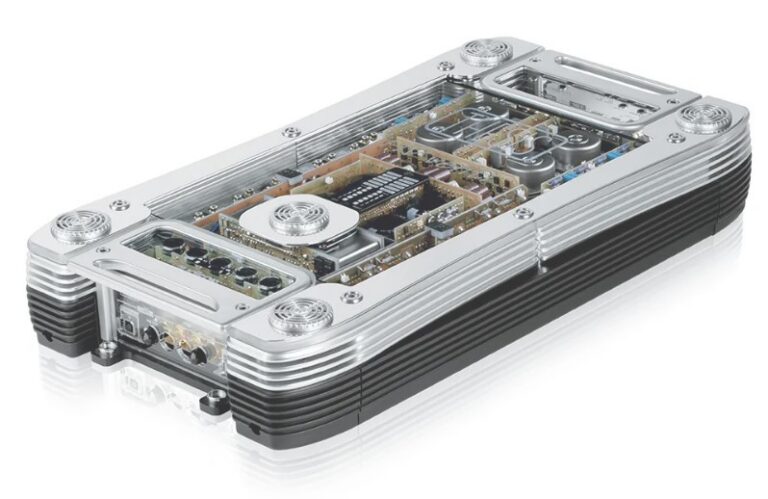
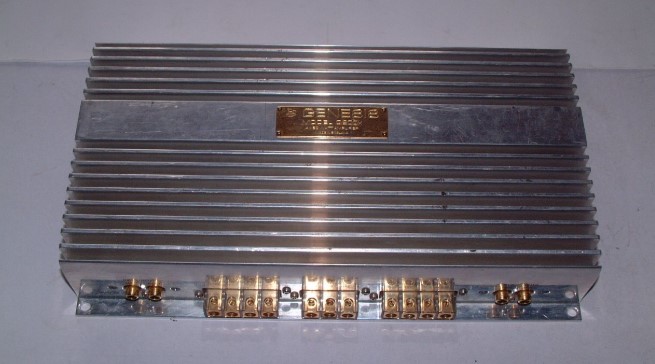
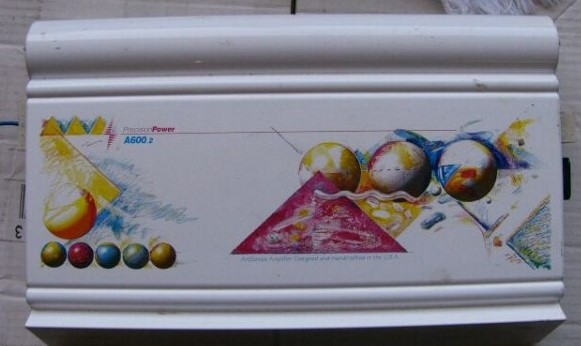
The amplifiers featured distinctive heatsink designs and graphics that immediately separated them from the many conventional amplifiers of the period.
Modern amplifiers are often designed to be compact, lightweight, and visually understated.
The Art Series was different.
During an era when amplifiers were often displayed proudly in the trunk, the amplifier itself could become part of the installation.
Opening the trunk was part of the experience.
And the PPI Art Series had the visual presence to make that experience memorable.
A600.2 — More Than a 600-Watt Amplifier
The name A600.2 can easily lead someone to think of it simply as a 600-watt amplifier.
But the A600.2 is actually a two-channel amplifier, with the following rated output:
- 150W × 2 @ 4Ω
- 300W × 2 @ 2Ω
- 600W × 1 @ 4Ω bridged
This made the amplifier surprisingly versatile.
It could be used as a conventional stereo amplifier for a front stage, or the two channels could be bridged to produce 600 watts for a single 4-ohm load.
For the systems of that era, this flexibility was extremely useful.
The Power Supply Is One of the Interesting Parts
One of the aspects of the A600.2 that deserves more attention is its power supply design.
A car is a difficult environment in which to operate an audio amplifier.
Unlike a home amplifier, it does not have access to a stable AC power source.
Vehicle voltage changes depending on operating conditions.
The voltage with the engine off is different from the voltage with the engine running, and the charging system introduces further variation.
For that reason, designing a good car audio amplifier is not simply about designing a good audio circuit.
The power supply is equally important.
The PPI Art Series used a regulated power supply designed to deal with variations in vehicle voltage and maintain its performance.
The design incorporated a PWM switching power supply and emphasized efficiency and thermal management.
This tells us something important about PPI.
The company was not simply trying to build an amplifier with a large power rating.
It was also paying attention to how that amplifier would perform inside an actual vehicle.
Why 150 Watts × 2 Still Makes Sense
By today’s standards, 150 watts may not sound particularly impressive.
Modern amplifiers can produce several hundred watts from a surprisingly small chassis.
But output power alone does not determine whether an amplifier is appropriate for a car audio system.
For a front-stage amplifier, 150 watts × 2 at 4 ohms is still plenty of power for many applications.
With the right speakers and crossover settings, an A600.2 can provide substantial power for a two-way front stage.
At 2 ohms, the amplifier can deliver 300 watts × 2.
That gives it additional flexibility when working with different speaker configurations.
600 Watts Bridged
Another interesting feature of the A600.2 is its bridged output.
By combining the two channels, the amplifier can deliver 600 watts into a 4-ohm load.
This means the A600.2 does not necessarily have to be used as a front-stage amplifier.
It can also be used to drive a subwoofer.
A system consisting of a two-way front stage and a single subwoofer could use the A600.2 in bridged mode for the subwoofer.
During the old-school era, using a two-channel amplifier in bridged mode for subwoofer duty was a common and practical approach.
This versatility was one of the strengths of the A600.2.
Why Do People Still Talk About the Sound?
There is a question that always comes up when discussing vintage car audio equipment:
Are old amplifiers really better than modern amplifiers?
There is no simple answer.
Modern amplifiers have evolved enormously.
They are smaller, lighter, more efficient, and often offer far more channels.
Modern Class D amplifier technology, in particular, has advanced dramatically.
But that does not make vintage analog amplifiers irrelevant.
Amplifiers such as the PPI Art Series have their own design philosophy and sonic character.
And in car audio, the sound of an amplifier cannot really be considered in isolation.
The head unit matters.
The equalizer matters.
The crossover matters.
The amplifier matters.
The speakers matter.
And, perhaps most importantly, the installation matters.
The combination of those components is what ultimately creates the character of a system.
That is why vintage car audio enthusiasts often spend as much time discussing combinations of equipment as they do individual products.
Think About It Together With the PPI EQ31
The recently featured PPI EQ31 is a perfect way to understand the era in which the A600.2 was created.
Today, most people would simply use a DSP for equalization.
Back then, a dedicated graphic equalizer was often an important part of the system.
A 31-band EQ could be used to shape the frequency response, while a separate crossover divided the signal between the speakers.
The amplifier then provided the power.
A system could therefore contain several separate pieces of equipment, each performing one specific task.
It was complicated.
But that complexity was also part of the fun.
You selected the equipment.
You connected everything.
You adjusted the gain.
You changed the crossover points.
You moved the EQ sliders.
Then you listened.
And you did it all again.
It was a completely different experience from opening a DSP software program and changing a few parameters on a screen.
The A600.2 and an Old-School Two-Way System
If I were building a vintage system around an A600.2 today, one of the most interesting approaches would still be a two-way front stage with a subwoofer.
A tweeter and midwoofer would handle the front stage, while a separate subwoofer would provide the low frequencies.
The A600.2 could be used as the front-stage amplifier, or bridged for subwoofer duty depending on the overall system design.
There is no need to keep adding speakers simply because more channels are available.
One of the lessons of old-school car audio is that system design and component matching often mattered more than simply increasing the number of speakers.
The Art Series Design
There is another reason the Art Series remains memorable:
the design.
Modern amplifiers are often extremely functional, but it can be difficult to find a product with a truly distinctive visual identity.
The PPI Art Series is different.
The large heatsink, distinctive construction, and individual graphics give the amplifier a strong visual personality.
During the era when amplifiers were commonly displayed in custom trunk installations, this mattered.
The amplifier was not something that simply had to be hidden away.
It could become part of the installation itself.
It was both an audio component and a piece of the overall design.
Finding a Good A600.2 Today
The passage of time has made good examples of the PPI Art Series increasingly interesting.
A vintage amplifier is not simply a matter of finding the correct model number.
Condition matters.
A unit may look excellent from the outside but have components inside that have deteriorated with age.
Another amplifier may function correctly but have significant cosmetic damage.
That is why anyone buying vintage equipment should consider the actual condition, service history, and internal condition rather than simply looking at the model name.
With older amplifiers, capacitors and other components can age over time, and equipment that has been stored unused for many years may require additional inspection.
In the vintage market, the value of a piece of equipment is not determined only by its original reputation.
It is also determined by how well that particular example has survived.
A Completely Different Experience From Today’s DSP Systems
I personally enjoy modern DSP-based car audio.
Time alignment is incredibly useful.
Channel levels can be adjusted precisely.
Equalization and crossover settings can be changed with remarkable flexibility.
But that does not mean the older approach was less interesting.
In fact, looking at an amplifier such as the PPI A600.2 together with equipment such as the PPI EQ31 makes it possible to see how car audio evolved.
In the past, each component had its own role.
The EQ was the EQ.
The crossover was the crossover.
The amplifier was the amplifier.
The listener or installer connected those components and built the system.
Today, a single DSP can perform many of those functions.
Technically, it is far more convenient.
But the older systems had a different kind of appeal.
K Sound Gear’s View of the PPI A600.2
It would be a shame to describe the PPI A600.2 simply as an “old 600-watt amplifier.”
What makes this amplifier interesting is that it represents a particular period in the history of American car audio.
150 watts × 2.
300 watts × 2 at 2 ohms.
600 watts bridged at 4 ohms.
A regulated power supply.
PWM power supply technology.
And the unmistakable Art Series design.
All of these elements come together in one amplifier.
And at the time, enthusiasts selected each component individually to create a complete system.
That is very different from today’s approach of using a DSP and a multi-channel amplifier to handle almost everything.
Final Thoughts
The PPI A600.2 is not special simply because it is old.
It is special because it represents what car audio valued during its era.
You chose a head unit.
You chose an equalizer.
You chose a crossover.
You chose an amplifier.
You chose the speakers.
And finally, you built the sound inside the vehicle.
Looking back, it was certainly more complicated.
But that process also created a stronger connection between the enthusiast and each individual piece of equipment.
The PPI A600.2 is one of the amplifiers that represents that era particularly well.
And perhaps that is why equipment like this continues to attract attention decades later.
It is not only because the equipment was good.
It is because the era in which these components were used has itself become part of car audio history.
At K Sound Gear, we want to look at vintage car audio equipment from more than just a specification sheet.
We want to explore when it was made, why it was made, how people used it, and why enthusiasts are still interested in it today.
Because old-school car audio is not just about old equipment.
It is about the history, the technology, the systems, and the people who built them.
That is the story K Sound Gear wants to continue documenting.