Panasonic CQ-TX5500W
The Most Unique Tube-Powered Car Audio Head Unit
When looking back at the history of car audio, there have been countless head units that stood out for one reason or another.
Some became famous for their sound quality. Others became legendary for their high-voltage preamp outputs and their role in the SPL scene. Some represented the cutting edge of digital technology at the time.
And then there are products that simply took a completely different approach.
The Panasonic CQ-TX5500W is one of those products.
Among the head units that will be featured on K Sound Gear, this may very well be the only true internally amplified head unit.
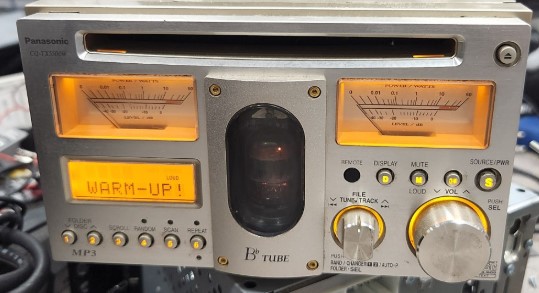
And the reason it is so special is immediately obvious when you look at the front panel.
There is a vacuum tube.
Putting a Vacuum Tube in a Car
When most people hear the words “vacuum tube,” they probably think of home audio, vintage amplifiers, or high-end tube equipment.
Putting a vacuum tube inside a car is a completely different matter.
A car is a harsh environment for electronic equipment. There is constant vibration while driving, extreme temperature changes, and considerable heat inside the vehicle during summer.
Yet Panasonic decided to bring vacuum-tube technology into a production car audio system.
The CQ-TX5500W appeared in the early 2000s as a CD receiver that actually incorporated a vacuum tube into its audio signal path.
And the tube was not simply there for decoration.
That is what makes this head unit particularly interesting.
The Tube Is Part of the Audio Circuit
The vacuum tube visible on the front panel is actually used in the audio signal path.
The digital audio information from the CD is converted into an analog signal through the D/A conversion stage, after which the signal passes through a vacuum-tube buffer circuit.
In other words, the tube is not simply a visual gimmick.
It actually participates in the processing of the music signal.
This makes the CQ-TX5500W fundamentally different from a head unit that merely uses a tube-shaped display or decorative element to create a vintage appearance.
Panasonic actually incorporated tube technology into the audio circuitry.
Digital CD Meets Vacuum-Tube Technology
The most fascinating aspect of the CQ-TX5500W may be the combination of technologies inside it.
Digital CD + D/A Conversion + Vacuum Tube
The CD itself is a completely digital source.
The digital information is converted back into analog audio through the D/A converter, and Panasonic then introduced a vacuum-tube stage into the signal path.
At a time when digital technology was rapidly becoming the dominant direction in car audio, Panasonic took a very different approach.
Instead of moving completely away from older analog technology, the company brought the vacuum tube back into the system.
And not into a home amplifier.
Into a car CD receiver.
And It Is an Internally Amplified Head Unit
The vacuum tube is not the only unusual thing about the CQ-TX5500W.
This is also an internally amplified CD receiver.
It features a built-in power amplifier capable of driving the vehicle’s speakers without requiring a separate amplifier.
At the same time, the unit also provides preamp outputs for connecting external amplifiers.
That means it can be used as a conventional head-unit-powered system, while also allowing the owner to expand the system with external amplification.
But the combination is what makes it so unusual:
Vacuum tube audio + built-in power amplifier + external amplifier capability.
That is a very rare combination in the history of car audio.
Why Use a Vacuum Tube in a Car?
The decision to use a vacuum tube inside a vehicle was certainly not an easy one.
Unlike a home audio system, a car is constantly exposed to vibration.
Temperature is another major issue. A vehicle can become extremely hot in the summer and very cold in the winter.
Vacuum tubes also generate heat and have very different physical characteristics from modern semiconductor devices.
So Panasonic had to engineer the tube application specifically for an automotive environment.
The fact that Panasonic went ahead with the idea at all makes the CQ-TX5500W an interesting example of engineering experimentation in car audio.
Even more interestingly, Panasonic did not hide the tube inside the chassis.
It was placed directly on the front panel where the user could see it.
The vacuum tube became part of the identity of the product itself.
A Head Unit You Could Actually Watch
Most modern head units are designed around screens and digital interfaces.
The CQ-TX5500W is completely different.
The glowing vacuum tube on the front becomes part of the experience.
Turning the system on and watching the tube operate would have been part of the appeal.
It is a perfect example of a time when car audio was not only about specifications and functions. The hardware itself could have personality.
The CQ-TX5500W looks like something that should belong in a vintage home audio system, yet it was designed to live inside a car.
That contrast is what makes it so memorable.
Panasonic’s Unusual Approach to High-End Car Audio
It would be easy to describe the CQ-TX5500W simply as “a strange head unit with a tube.”
But that would miss the bigger picture.
Panasonic was combining several very different concepts into a single product.
A digital CD source.
A D/A conversion stage.
A vacuum-tube buffer.
A built-in power amplifier.
And preamp outputs for an external amplifier system.
It was an unusual attempt to combine digital technology with the character of analog tube circuitry.
At the beginning of the 2000s, this was certainly not the obvious direction for automotive audio.
That is precisely why the CQ-TX5500W remains so interesting today.
Why It Still Stands Out Today
Modern car audio has moved dramatically toward DSP processing, digital inputs, network audio, smartphones, and highly integrated systems.
Vacuum tubes are almost completely absent from modern automotive head units.
Looking back at the CQ-TX5500W today therefore gives us a glimpse of a very different philosophy.
Panasonic did not simply follow the digital trend.
Instead, the company experimented with bringing an old technology back into a modern digital product.
And they did it in a car.
That makes the CQ-TX5500W more than just an unusual piece of vintage equipment.
It represents a period when manufacturers were still willing to experiment with unconventional ideas.
A Special Place at K Sound Gear
K Sound Gear will eventually feature many different types of head units.
There will be high-end source units designed primarily for sound quality.
There will be competition-oriented units built for high-output systems.
There will be legendary digital processors and source units that helped define their respective eras.
The CQ-TX5500W occupies a completely different position.
It may very well be the only internally amplified head unit featured on K Sound Gear.
Of course, there are still countless vintage car audio products out there, so it would be difficult to claim that no other example ever existed.
But among the head units featured here, a product combining a genuine vacuum-tube audio stage with a built-in power amplifier is certainly going to be a very rare exception.
Panasonic CQ-TX5500W
The CQ-TX5500W represents one of Panasonic’s most unusual experiments in automotive audio.
A digital CD source.
D/A conversion.
A real vacuum-tube buffer stage.
A built-in power amplifier.
And the ability to connect external amplification.
All of these technologies were brought together in one car audio head unit.
And Panasonic did not hide the most unusual part.
The vacuum tube was placed right on the front panel for everyone to see.
Perhaps that is why the CQ-TX5500W remains so memorable.
Not because it had the highest specifications of its era, but because Panasonic was willing to ask a very unusual question:
What if we put a vacuum tube in a car stereo?
And then they actually built it.
For K Sound Gear, that makes the Panasonic CQ-TX5500W a particularly special piece of car audio history — and quite possibly the only internally amplified head unit in the collection.