Sony CDX-C90 & XDP-4000X
From XES-P1 to XES-Z50, and Finally to a More Flexible High-End System
When talking about Sony’s high-end car audio history in the 1990s, one name inevitably comes up:
Mobile ES.
Within that legendary lineup, several products stand out — the early XES-P1, the 1996 XES-Z50, and later, the CDX-C90 and XDP-4000X.
At first glance, they may all appear to be high-end Sony car audio components from different generations. But simply describing them as old and new models doesn’t really explain their significance.
Throughout the 1990s, Sony continued developing its approach to high-end car audio, particularly in the areas of digital signal processing, time alignment, crossover control, and sound-field optimization.
And at the end of that long development path came the C90.
The C90 was not simply a less expensive version of the XES-Z50, nor was it merely a direct successor to the XES system.
Instead, it represented a different approach: taking the technology and philosophy Sony had developed through XES and incorporating them into a more independent and flexible Mobile ES high-end system.
It Started with the XES-P1
To understand Sony’s high-end car audio history, we first have to look at the early XES-P1.
The Sony Mobile ES systems of the early 1990s were very different from conventional car audio systems of the time.
Rather than putting every function into a single head unit, Sony separated the system into individual components.
There were dedicated units for:
- Source
- Digital processing
- Digital crossover
- Amplification
- Speakers
Early systems included components such as the P1, X1, T1, C1, M1, and M3.
Looking at it from today’s perspective, the concept feels surprisingly familiar.
The difference was that, instead of one compact DSP handling everything, each function was handled by a dedicated piece of hardware.
The P1 Was Already Ahead of Its Time
One of the most interesting aspects of the XES-P1 was its approach to digital sound processing.
Sony was already addressing one of the biggest problems in car audio: the fact that the driver is not sitting exactly between the left and right speakers.
The distance from the driver to each speaker is different, meaning the sound from each speaker reaches the listener at a different time.
Sony addressed this problem through digital processing, including Digital Time Alignment.
The company was already treating the vehicle cabin as an acoustic environment that needed to be digitally controlled rather than simply relying on speaker quality alone.
This was an extremely advanced concept for the early 1990s.
The Beginning of Sony’s Digital Car Audio Philosophy
The early Mobile ES systems are fascinating because their basic philosophy is still familiar today.
There is a source.
There is a processor.
There is a crossover.
There are amplifiers.
And there are dedicated speakers for each frequency range.
Today, a single DSP can perform many of these functions.
Back then, however, Sony distributed those functions across multiple components.
The installer had to combine all of these pieces into one complete system.
That was the essence of high-end car audio in the 1990s.
1996 — The XES-Z50
Sony continued developing this philosophy, and in 1996 the company introduced a new flagship XES system.
At the center of that system was the XES-Z50.
Sony officially announced the new XES system on October 7, 1996.
The Z50 was much more than a conventional head unit.
It was the central component of a complete high-end XES system, combining CD and digital preamplifier functions with advanced digital processing.
Sony applied an extremely sophisticated DSP architecture, including a 4095-tap FIR digital filter.
The system also offered digital crossover processing, parametric EQ, and time alignment.
Considering that this was 1996, the level of digital processing was remarkable.
The XES-Z50 Was Sony’s Vision of a Complete High-End System
The significance of the Z50 was not simply the number of features it offered.
Sony designed the XES system as a complete high-end ecosystem.
The Z50 was paired with dedicated components such as:
XES-M50
XES-H50
XES-F50
XES-L50
Sony’s proposed basic XES system included the Z50, three M50 amplifiers, H50 and F50 speakers, and two L50 subwoofers.
The complete system was priced at approximately 1.27 million yen at the time.
This was clearly far beyond ordinary car audio.
The XES-Z50 represented Sony’s statement of what the company believed was possible in a true high-end automotive audio system.
In other words:
“This is what Sony can build when there are virtually no compromises.”
So Why Did Sony Introduce the C90?
This is where the story becomes particularly interesting.
If Sony already had the XES-Z50, why introduce another high-end CD source a few years later?
The answer is important for understanding the C90.
It would be too simple to describe the C90 as:
“A cheaper version of the XES-Z50.”
That does not really capture its purpose.
The C90 represented a different approach from the beginning.
The XES-Z50 Was a Complete System
The philosophy behind the XES-Z50 was straightforward.
Sony designed the source, processing, amplifiers, and speakers as one complete system.
The user could build the system according to Sony’s specifications.
The Z50 was the center.
The M50 amplifiers powered the system.
The H50 and F50 handled the front stage.
The L50 handled the low frequencies.
Everything was designed to work together as part of the XES concept.
That was the world of XES.
The C90 Took a Different Direction
The C90 was different.
The CDX-C90 was an independent Mobile ES high-end source unit.
Instead of being the center of a complete XES ecosystem, it could be combined with external processing and other manufacturers’ amplifiers and speakers.
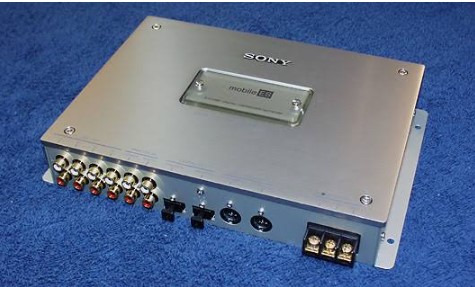
One of the most famous combinations was the XDP-4000X.
The C90 handled the CD source.
The XDP-4000X handled the digital processing.
And beyond that, the owner could choose the amplifiers and speakers.
In other words, rather than saying:
“Build Sony’s complete XES system.”
the concept became:
“Start with a high-quality Sony source and build your own high-end system.”
That distinction is extremely important.
The C90 Was Not Simply a Lower-Cost XES
This is perhaps the most important point when discussing the C90.
Calling it a “budget XES” would oversimplify its position.
The significance of the C90 was not simply that Sony lowered the price.
It was that Sony offered considerably more freedom in system design.
With the C90, the owner could choose the amplifier.
They could choose the speakers.
They could choose the processing system.
And they could build the system around their own preferences and budget.
The C90 therefore opened the door to a more flexible form of high-end car audio.
It was still an expensive, serious piece of equipment.
But it was no longer necessary to build an entire XES system around Sony’s dedicated components.
And Then Came the XDP-4000X
This is where the XDP-4000X becomes an important part of the story.
The combination of C90 and XDP-4000X could form an extremely sophisticated high-end system.
The C90 provided the source.
The XDP-4000X handled the processing.
The processed signal could then be sent to multiple amplifiers and individual speaker channels.
The basic structure was:
CDX-C90
↓
XDP-4000X
↓
Multiple Amplifiers
↓
Speakers
From today’s perspective, this looks remarkably similar to a modern DSP-based system.
The C90 Was About System Freedom
The real attraction of the C90 was therefore not simply its CD playback.
It was the ability to use it as the foundation of a serious system.
You could build a two-way front stage.
You could create a multi-amplifier setup.
You could use different brands of amplifiers.
You could choose your own speakers.
And with the XDP-4000X, you could control the crossover, EQ, timing, and overall system balance.
The C90 became the source at the heart of a system rather than simply another component in a predetermined package.
Sony Had Been Developing This Philosophy for Years
The C90 and XDP-4000X did not suddenly introduce Sony to digital sound processing.
The technology had been developing for years.
The XES-P1 had already incorporated digital time alignment.
The XES-Z50 pushed Sony’s digital processing technology even further.
And the C90/XDP-4000X combination continued that philosophy in a different system architecture.
This is what makes the history so interesting.
Sony wasn’t simply adding more features with each generation.
The company was continuously refining the idea of how digital technology could be used to control the acoustics of a car.
High-End Car Audio Was Also About Installation
Today, opening a DSP program on a laptop gives us access to an enormous amount of control.
We can select a channel.
Set a crossover frequency.
Enter a delay value.
Adjust the EQ.
Measure the response.
And repeat the process.
In the 1990s, things were very different.
The equipment had to be installed physically.
The wiring had to be planned.
The processor had to be configured.
And the system had to be evaluated by listening to music over and over again.
Ultimately, the final decision still came down to the installer and the listener.
That is why high-end car audio from this era was not simply about buying expensive equipment.
It was about:
Equipment + Installation + Tuning
All three were equally important.
XES-P1 → XES-Z50 → C90
Sony’s high-end car audio history can be summarized like this.
XES-P1
Early 1990s
One of the representative components of Sony’s early Mobile ES systems.
Already incorporating advanced digital sound processing concepts, including Digital Time Alignment.
XES-Z50
1996
The centerpiece of Sony’s flagship XES system.
It combined advanced digital processing with the XES concept of a complete, purpose-built high-end system.
Its technology included a 4095-tap FIR digital filter, digital crossover processing, parametric EQ, and time alignment.
CDX-C90 + XDP-4000X
Late 1990s
The C90 became an independent high-end Mobile ES CD source, while the XDP-4000X provided external digital processing.
Together, they allowed users to create sophisticated multi-amplifier systems without being tied to the complete XES ecosystem.
Why the C90 Still Matters
If you look at the C90 simply as an old Sony CD player, there is nothing particularly mysterious about it.
But once you understand its history, the picture changes.
Sony started with the early Mobile ES systems and the XES-P1.
The company then pushed its technology to an extreme with the XES-Z50 and the flagship XES system.
And afterward, Sony introduced the C90 as a high-end source that could be used much more freely within an individual system.
The C90 was not simply the next model.
It represented another stage in the evolution of Sony’s high-end car audio philosophy.
The Meaning of C90 + XDP-4000X
The value of the C90 lies in what it allows you to build around it.
The source can be the C90.
The processor can be the XDP-4000X.
The amplifiers can be selected according to the system.
The speakers can be selected according to personal taste.
The crossover can be configured.
The EQ can be adjusted.
The timing can be aligned.
And ultimately, the entire system can be tuned around the driver’s seat.
This is why the C90 remains such an interesting piece of old-school high-end car audio.
It was not trying to do everything by itself.
It was designed to become the heart of a system.
Looking Back at the C90 Today
Compared with modern car audio, the C90 is obviously inconvenient.
It plays CDs.
It does not have USB streaming.
It does not have Bluetooth.
It does not have the modern graphical interface we take for granted today.
But the philosophy behind it remains surprisingly relevant.
A good source.
A good processor.
Proper crossover control.
Accurate time alignment.
Good amplifiers.
Good speakers.
And, most importantly, proper tuning.
Those principles have not changed nearly as much as the technology has.
Conclusion
When looking at Sony’s high-end car audio history during the 1990s, a fascinating progression emerges.
XES-P1
The early development of Sony’s digital approach to automotive sound.
↓
XES-Z50
Sony’s flagship XES system, pushing digital processing and high-end system design to an extreme.
↓
CDX-C90 + XDP-4000X
A more flexible, independent high-end Mobile ES platform that allowed enthusiasts to build their own systems.
This is why describing the C90 simply as a cheaper XES-Z50 doesn’t quite work.
The real significance of the C90 was freedom of system design.
The XES-Z50 represented a complete world created by Sony.
The C90 allowed the user to create their own world around a high-end Sony source.
And when combined with the XDP-4000X, it became possible to build a sophisticated system with digital processing, crossover control, time alignment, multiple amplifiers, and individually selected speakers.
Compared with today’s DSP systems, the hardware may seem old.
But the fundamental philosophy is remarkably similar.
Start with a good source.
Divide the frequency bands.
Control the timing.
Tune the response.
Use dedicated amplification.
And build the soundstage around the driver’s seat.
The technology has changed dramatically over the past three decades.
The fundamental goal has not.
And that is exactly why the Sony CDX-C90 + XDP-4000X remains such a fascinating combination.
It represents an era when Sony’s long development of high-end digital car audio had matured into a system that enthusiasts could make their own.
From XES-P1, to XES-Z50, and finally to C90.
Not simply a succession of products, but a story about how Sony continued to rethink what high-end car audio could be.
K Sound Gear — Old School Car Audio, Remembered.