PPI FRX-456
An Iconic Old-School Active Crossover
In today’s car audio systems, crossover functions are usually built into DSP processors. A single DSP can handle crossover points, slopes, EQ, time alignment, phase, routing, and much more.
But things were very different during the golden era of American car audio.
In the 1990s and early 2000s, a serious high-end system often used a dedicated active crossover between the head unit and multiple amplifiers.
One of the most interesting examples from that era is the Precision Power FRX-456.
What Is the PPI FRX-456?
Precision Power, better known as PPI, is one of the legendary names in American old-school car audio.
The FRX-456 was designed as a sophisticated active electronic crossover for multi-amplifier systems.
Rather than simply splitting a signal into two frequency ranges, the FRX-456 was designed for complex multi-way systems and could be configured for 2-way, 3-way, and 4-way active applications.
This made it possible to build a system in which each speaker had its own amplifier channel and received only the frequencies it was designed to reproduce.
The result was a much more flexible alternative to passive crossover networks.
Why Is the FRX-456 Special?
The biggest attraction of the FRX-456 is its simplicity.
Modern DSP processors can provide hundreds of possible adjustments through computer software.
The FRX-456 takes a completely different approach.
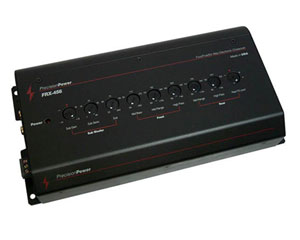
The important controls are right on the front panel.
Frequency settings are selected using physical controls, allowing the user to configure the crossover without a computer, software, or smartphone.
PPI used detented frequency selection controls, meaning the available frequency points are clearly defined rather than continuously variable.
Today this may seem primitive compared with a modern DSP.
At the time, however, it was a very practical and intuitive way to tune a serious car audio system.
Designed for Multi-Way Active Systems
The FRX-456 was designed to support sophisticated active systems.
A typical system could be configured as:
2-Way
Midbass / Tweeter + Subwoofer
The midbass and tweeter are powered independently, while the subwoofer is driven by a separate amplifier.
3-Way
Midbass / Midrange / Tweeter + Subwoofer
This configuration allows each section of the front stage to have its own amplifier and dedicated frequency range.
4-Way
The system can be divided even further, creating a highly specialized multi-amplifier installation.
This flexibility is one reason the FRX-456 was much more than a basic crossover.
It was designed as the control center of a serious active car audio system.
Linkwitz-Riley Filters
One of the most important technical features of the FRX-456 is its use of Linkwitz-Riley crossover filters.
The subwoofer section uses a 24 dB/octave slope.
The midbass, midrange, and high-pass sections use 12 dB/octave filtering.
The crossover slope determines how quickly the signal is attenuated outside the selected frequency range and plays an important role in how different drivers blend together.
For its era, the FRX-456 offered a sophisticated filtering architecture for high-end active systems.
Crossover Frequency Range
The FRX-456 provides a wide range of selectable crossover frequencies.
Depending on the section, the available frequency ranges include:
- Front high-pass: approximately 80 Hz to 20 kHz
- Midrange: approximately 80 Hz and upward
- Midbass: approximately 55 Hz to 500 Hz
- Rear: approximately 80 Hz to 20 kHz
- Subwoofer low-pass: approximately 20 Hz to 270 Hz
- Subsonic filter: approximately 7 Hz to 46 Hz
The exact available frequency points depend on the individual section.
The wide adjustment range made the FRX-456 suitable for everything from relatively simple 2-way systems to much more elaborate multi-way installations.
Dedicated Subwoofer Control
The FRX-456 also includes several controls specifically designed for subwoofer management.
These include:
- Subwoofer level control
- Low-pass gain
- Subsonic filtering
The subsonic filter is particularly useful for removing extremely low frequencies that a subwoofer does not need to reproduce.
This can help control unnecessary cone movement and improve system performance.
For the high-output subwoofer systems popular during the American car audio era, this was a useful feature.
Rear Fill Control
Another interesting feature is the Rear Fill Level Control.
Rear fill was much more common in old-school car audio systems than it is in many modern SQ-focused installations.
Today, many high-end systems concentrate almost entirely on the front soundstage.
During the era of the FRX-456, however, rear speakers were frequently used to create a larger sense of space inside the vehicle.
The dedicated rear level control allowed the installer to adjust the contribution of the rear channels without affecting the main front stage.
Input Combine
The FRX-456 also includes an Input Combine function.
This allows the front and rear inputs to be combined for certain system configurations.
It was useful when working with head units that had limited RCA outputs or when creating a particular signal-routing configuration.
The unit also provided input attenuation, allowing it to work with higher-voltage RCA signals and different types of source equipment.
These features made the FRX-456 practical for the wide variety of head units and amplifiers available during the period.
Gold RCA Connections and Analog Design
The FRX-456 has the unmistakable appearance of an old-school PPI component.
The unit uses gold-plated RCA connectors and was built around a traditional analog crossover architecture.
PPI designed the FRX-456 in the United States as a dedicated component for high-performance car audio systems.
The philosophy was not to provide an endless number of features.
Instead, the goal was simple:
Provide the tools needed to properly divide and control the signal in a serious multi-amplifier system.
What Does the FRX-456 Sound Like?
This is where things become subjective.
The FRX-456 is not an EQ or sound processor designed to deliberately create a particular tonal character.
Therefore, it would be misleading to simply describe it as “warm” or “bright.”
Its character is better understood through its function.
The FRX-456 is designed to provide:
Clean frequency separation
Clear driver integration
Controlled bass
Defined midrange
And a focused soundstage
The actual result depends heavily on the amplifiers, speakers, installation, source unit, crossover settings, and system tuning.
A properly configured active system can sound remarkably coherent because each driver is working within a dedicated frequency range and is powered independently.
FRX-456 vs. a Modern DSP
Comparing the FRX-456 with a modern DSP reveals a huge difference in functionality.
A modern DSP can provide:
- Multiple parametric EQ bands
- Independent left/right EQ
- Precise time alignment
- Variable crossover slopes
- Phase adjustment
- Flexible signal routing
- Input mixing
- Output mixing
- Computer-based tuning
The FRX-456 cannot do most of these things.
So why is it still interesting today?
Because of its simplicity.
Connect the RCA cables, power it up, and adjust the physical controls.
There is no computer.
No software.
No firmware.
No smartphone app.
Everything you need to adjust is directly in front of you.
That is one of the defining characteristics of old-school active crossovers.
The Perfect Partner for PPI Amplifiers
The FRX-456 becomes even more interesting when paired with PPI amplifiers.
A classic PPI system could look something like this:
Head Unit
↓
PPI FRX-456
↓
Multiple PPI Amplifiers
↓
Multi-Way Speakers + Subwoofer
This type of system represents the classic American high-end car audio philosophy of the era.
Instead of putting everything into a single DSP amplifier, the system was built from individual components.
The crossover handled the signal distribution.
Multiple amplifiers provided the power.
And the installer tuned the entire system manually.
The Real Appeal of the FRX-456
The real appeal of the FRX-456 is not that it has more features than a modern DSP.
It is actually the opposite.
It does fewer things — but the things it does are clear and purposeful.
During the 1990s and early 2000s, building a high-end car audio system often meant choosing a head unit, active crossover, multiple amplifiers, speakers, and subwoofers separately.
The installer then had to make all of those components work together.
The FRX-456 was designed for exactly that kind of system.
Why the FRX-456 Still Matters
Today, a modern DSP can replace almost everything the FRX-456 does.
From a purely technical perspective, there is little reason to choose an FRX-456 over a modern DSP if maximum flexibility is the goal.
But that is not why people are interested in it today.
The FRX-456 represents an important period in car audio history.
It comes from an era when active crossover technology was becoming an essential part of high-end automotive sound systems, but before DSPs became the universal solution.
It is a physical reminder of how serious car audio systems were built before software took over the tuning process.
Final Thoughts
The PPI FRX-456 is more than an old crossover.
It represents a different approach to car audio.
An approach based on individual components, multiple amplifiers, active speaker control, and hands-on tuning.
It supported sophisticated multi-way systems, used Linkwitz-Riley filtering, offered extensive crossover frequency selection, and provided practical controls for subwoofer and rear-fill management.
Today, a single DSP can perform all of these functions and much more.
But the FRX-456 has something a modern DSP does not:
character and history.
It represents the era when building a serious car audio system meant physically connecting each component and tuning the system by hand.
That is exactly what makes the PPI FRX-456 worth remembering.
K_sound_gear
Old School Car Audio · DSP · Crossover · Amplifier · Speaker
Old car audio equipment is more than used equipment.
Every piece has a story — its technology, its sound, and the era in which it was created.
K_sound_gear documents those stories.