
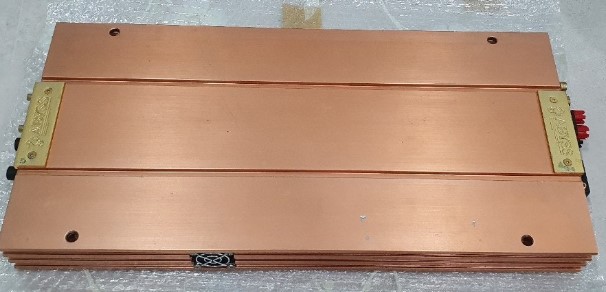
ABYSS MFA-7
The Korean Amplifier That Put ABYSS on the Map
When people talk about legendary old-school car audio amplifiers, the conversation usually centers on American, Japanese, or European brands.
But Korea also produced some remarkably ambitious high-end car audio equipment.
One of the names that deserves to be remembered is ABYSS, and one amplifier in particular became closely associated with the brand:
The ABYSS MFA-7.
The MFA-7 was not a product that appeared after ABYSS was revived. It was already an established amplifier during the original era of the company and became one of the products that built ABYSS’s reputation.
ABYSS itself describes the MFA-7 series as the amplifier that “put Abyss on the map.” The company also states that the MFA-7 design had already existed in Korea and Asia before a similar amplifier appeared under another brand. (Abyss Car Audio)
The Story of ABYSS
ABYSS is a particularly interesting name in Korean car audio history because its story is not a simple one.
The original ABYSS developed high-end, audiophile-oriented car audio amplifiers in Korea and became known among enthusiasts who were looking for something beyond conventional mass-market equipment.
The brand eventually disappeared from the market, but it was later revived, bringing back some of the designs associated with the original ABYSS era.
This distinction is important when discussing the MFA-7.
The 2015 revival was not the beginning of the MFA-7.
The MFA-7 was already being discussed and sold years earlier. A 2011-era car audio forum archive, for example, lists the MFA-7 2-channel and gives detailed specifications for the model. (Tapatalk)
The MFA-7 Family
The MFA-7 was produced in both 2-channel and 4-channel configurations.
Although they share the MFA-7 name, the two versions were designed for different applications.
The 2-channel version is particularly interesting for high-end front-stage systems, while the 4-channel version is better suited to systems requiring multiple channels of amplification.
MFA-7 2-Channel
The currently published ABYSS specifications list:
| Specification | MFA-7 2-Channel |
|---|---|
| Output @ 4Ω | 250 W × 2 |
| Output @ 2Ω | 430 W × 2 |
| Bridged | 850 W × 1 @ 4Ω |
| Operating Voltage | 9–16 V |
| Amplifier Configuration | Class AB |
| Power Supply | PWM |
| Damping Factor | >200 |
| Dimensions | 265 × 53 × 554 mm |
| Weight | 8 kg |
ABYSS also specifies WIMA capacitors, IRF044N power MOSFETs, and a Burr-Brown OPA2604 low-noise op-amp in the published MFA-7 2-channel specification. (shokindustries)
These specifications should be distinguished from older historical documents, which list substantially higher output figures for an earlier MFA-7 2-channel configuration, including 300 W × 2 at 4Ω, 550 W × 2 at 2Ω, and 1,000 W × 2 at 1Ω. (Tapatalk)
That difference is important.
Rather than mixing the specifications of different generations together, it is more accurate to treat the original and later MFA-7 versions separately.
The MFA-7 4-Channel
The 4-channel MFA-7 was designed for systems that required more amplifier channels.
The current ABYSS specification lists:
- 125 W × 4 @ 4Ω
- 200 W × 4 @ 2Ω
- 400 W × 2 bridged
- Class AB output stage
- PWM power supply
- Damping factor greater than 200
- 265 × 53 × 554 mm
- 8 kg
The published specifications also list WIMA capacitors, IRF044N power MOSFETs, and Burr-Brown OPA2604 devices. (Abyss Car Audio)
Interestingly, historical material contains a 175 W × 4 figure for an MFA-7 4-channel version.
Because the standard ABYSS specification lists 125 W × 4 while historical material shows 175 W × 4, the 175 W version should not automatically be treated as the standard production specification.
It may represent an earlier, special, or otherwise different configuration.
This is exactly the kind of detail that makes researching old car audio equipment so interesting.
A True Audiophile-Oriented Design
The MFA-7 was designed around a very different philosophy from many modern amplifiers.
Today, an amplifier is often expected to include DSP, EQ, crossover functions, networking, Bluetooth, and smartphone control.
The MFA-7 does none of that.
It is an amplifier in the traditional sense.
The signal comes in.
The amplifier provides the power.
And the rest of the system is handled by separate components.
This was the classic high-end car audio approach:
Head Unit
↓
DSP / Active Crossover
↓
Amplifier
↓
Speakers
The MFA-7 fits perfectly into that architecture.
Class AB Amplification
The MFA-7 uses a Class AB output stage.
Class AB was one of the dominant designs for high-end analog amplifiers during the golden era of car audio.
It offered a practical compromise between the efficiency of Class B and the low-distortion characteristics associated with Class A operation.
For a car audio amplifier, this was particularly important.
A vehicle’s electrical system has limited power available, so an amplifier has to balance efficiency with sound quality.
The MFA-7’s design reflects the priorities of that era: substantial output power combined with an analog amplifier architecture aimed at high-quality reproduction.
Components Matter
One of the more interesting aspects of the MFA-7 is the component selection.
The current ABYSS documentation specifically mentions:
WIMA capacitors
IRF044N power MOSFETs
Burr-Brown OPA2604 op-amps
These were not chosen simply because they were inexpensive, generic components.
The use of well-regarded audio components fits the overall audiophile positioning of the MFA-7.
It is one of the reasons why the amplifier is interesting to enthusiasts who appreciate the engineering of older analog equipment. (shokindustries)
A Remarkably Large Chassis
The MFA-7 is also physically substantial.
At approximately:
265 × 53 × 554 mm
and around 8 kg, it is a large amplifier.
The long chassis is typical of many high-end amplifiers from the period.
Unlike modern compact Class D amplifiers, the MFA-7 was designed as a substantial standalone component.
There is something very different about an amplifier like this.
The physical size, heat dissipation, power supply, and internal components all contribute to the feeling that the amplifier was designed as a serious piece of hardware rather than simply another accessory.
The Connection With Other Brands
Perhaps the most fascinating part of the MFA-7 story is its connection to other brands.
ABYSS openly acknowledges that the MFA-7 may look familiar to enthusiasts who have seen another amplifier sold under a different name.
According to ABYSS, the MFA-7 series was already present in Korea and Asia before the other brand, and the basic PCB layout had been around for many years. (Abyss Car Audio)
This is an important part of Korean car audio history.
It demonstrates that Korean manufacturers were not simply importing finished technology.
They were also involved in design, engineering, manufacturing, and OEM production for the international car audio market.
For this reason, the MFA-7 is interesting not only as an amplifier, but also as an example of Korea’s role in the international car audio industry.
The MFA-7 and the TUBE-4100
The MFA-7 was also part of the development path that eventually led to other unusual ABYSS products.
One of the most interesting examples is the TUBE-4100.
Historical Korean material describes the TUBE-4100 as a successor to the MFA-7 and highlights its hybrid approach, combining vacuum tubes in the input stage with FET devices in the output stage.
This was a very different approach from conventional mass-market car amplifiers.
The idea was to combine the sonic characteristics associated with tube circuitry with the power capability of a solid-state output stage.
The TUBE-4100 therefore represents an interesting evolution of the engineering philosophy behind the MFA-7.
The End of the Original ABYSS
The original ABYSS era eventually came to an end.
The company later disappeared from the market, leaving behind a relatively small but interesting collection of amplifiers.
For enthusiasts today, this is part of what makes the brand so intriguing.
ABYSS was never a mass-market giant.
Its products were relatively specialized and aimed at enthusiasts who were willing to spend money on unusual, high-end equipment.
As a result, surviving examples are much less common than amplifiers from major American or Japanese manufacturers.
The ABYSS Revival
ABYSS eventually returned to the market.
The revived company retained the MFA-7 name and continued to promote the design as an important part of the brand’s history.
ABYSS describes the MFA-7 as a timeless design and emphasizes that the MFA-7 platform was already established many years before the revival. (Abyss Car Audio)
This makes the MFA-7 unusual compared with a typical modern product.
It is not simply a newly designed amplifier carrying an old model number.
The model is directly connected to the engineering history of the original ABYSS.
What Does the MFA-7 Sound Like?
It is difficult to describe the sound of an amplifier objectively without controlled measurements.
The final result depends on the source, crossover, speakers, installation, gain structure, and tuning.
However, the MFA-7’s design philosophy clearly places it in the high-end analog amplifier category.
The combination of a Class AB output stage, substantial power capability, high damping factor, wide-bandwidth design, and audiophile-oriented components suggests an amplifier designed to provide control and transparency rather than artificial coloration.
For an old-school active system, that makes a lot of sense.
The amplifier can be paired with a dedicated crossover or DSP, allowing the amplifier itself to concentrate on its primary task:
driving the speakers.
Why the MFA-7 Is Important
The MFA-7 is important because it challenges the common perception that high-end Korean car audio simply followed overseas manufacturers.
The story is more complicated.
Korean engineers and manufacturers were developing sophisticated amplifiers, and ABYSS was one of the companies that pushed particularly hard toward the audiophile end of the market.
The MFA-7 became an important part of that story.
Its history also illustrates something else:
A good amplifier design can survive its original manufacturer.
The MFA-7 disappeared, ABYSS disappeared, and eventually the brand returned.
Yet the MFA-7 design remained important enough to be brought back.
Final Thoughts
The ABYSS MFA-7 is not famous because it has the largest power rating or the most modern features.
It is interesting because of what it represents.
It represents a period when high-end car audio was built from individual components.
It represents Korean engineering during an important period in the development of the country’s car audio industry.
And it represents an amplifier designed with an audiophile philosophy rather than simply competing on specifications.
The MFA-7 also has a fascinating international story, with ABYSS itself acknowledging its relationship to similar products sold under other names.
For those reasons, the MFA-7 deserves to be remembered as one of the more interesting Korean high-end car audio amplifiers.
Not simply because it was made in Korea.
But because it was ambitious enough to compete in a world dominated by American, Japanese, and European brands.
K_sound_gear
Korean Car Audio · Old School Car Audio · Amplifier · DSP · Analog Crossover
Old car audio equipment is more than used equipment.
Every amplifier, processor, crossover, and head unit tells a story about the technology, engineering, and people behind it.
K_sound_gear documents those stories.