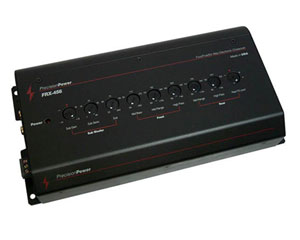

AudioControl 4XS
A Legend of the Analog Crossover Era
When looking back at the history of car audio, there are certain pieces of equipment that represent an entire era.
Some are head units.
Some are amplifiers.
Others are speakers and subwoofers.
But there were also components that played a much more important role behind the scenes — equipment that helped define how an entire car audio system was built.
One of those components was the active crossover.
Today, a modern DSP can handle almost everything inside a single unit.
Crossover points, slopes, equalization, phase, delay, time alignment, and countless other adjustments can all be controlled from a computer or smartphone.
But before DSP became the standard, high-end car audio systems worked very differently.
The head unit provided the source.
The active crossover divided the signal.
Multiple amplifiers powered different sections of the system.
And the installer had to bring everything together and tune it by hand.
During that era, the active crossover was often at the heart of a serious multi-amp system.
And among the products that became especially well known was the AudioControl 4XS.
Before the 4XS
First, one thing should be made clear.
The 4XS was not the first active crossover ever made.
Electronic active crossovers had already existed for many years, both in professional audio and in car audio.
Several manufacturers had already developed active crossover systems for high-performance applications before the 4XS appeared.
AudioControl itself had also produced the 2XS, an earlier active crossover designed primarily for 2-way applications.
However, the 2XS and 4XS should not simply be described as the same type of product.
The 2XS was fundamentally a 2-way active crossover, while the 4XS was designed to offer much greater flexibility for more sophisticated system configurations.
That distinction is important.
The significance of the 4XS was not that it invented the concept of active crossovers.
Its importance came from how effectively it brought active signal processing into the kind of multi-amp car audio systems that serious enthusiasts were building at the time.
The Era of Multi-Amp Car Audio
To understand the 4XS, you have to understand the car audio systems of the 1990s and early 2000s.
Today, connecting a DSP to several amplifiers and configuring every channel independently is relatively straightforward.
Back then, many of those functions were handled by separate pieces of hardware.
A typical high-end system might look something like this:
Head Unit
↓
Active Crossover
↓
Front Amplifier
Rear Amplifier
Subwoofer Amplifier
And more elaborate systems could go even further, dividing the front stage into multiple frequency bands and assigning separate amplifier channels to each section.
This was the era of the multi-amp system.
Rather than asking one amplifier to power every speaker in the vehicle, enthusiasts could choose different amplifiers for different parts of the system.
A powerful amplifier could be dedicated to the subwoofer.
Another amplifier could handle the front stage.
Additional amplifier channels could be used for midrange or tweeter sections.
This gave the installer a tremendous amount of freedom.
But that freedom also created a problem.
All of those amplifiers needed the correct signal.
That was where the active crossover came in.
More Than Just a Crossover
The basic job of an active crossover is simple:
Divide the audio signal into the frequency ranges required by the system.
Low frequencies can be sent to the subwoofer amplifier.
Higher frequencies can be directed toward the front speakers.
More complex systems can divide the signal into additional bands.
But in a serious car audio system, the crossover was more than just a frequency divider.
It became part of the overall system design.
The crossover determined how the different sections of the system interacted with one another.
Where the subwoofer stopped.
Where the midbass began.
Where the upper frequencies were handed over to the tweeters.
And how the levels between those sections were balanced.
That made the active crossover a critical part of the system.
The AudioControl 4XS was designed for exactly this kind of environment.
Simple Operation
One of the things that makes the 4XS particularly interesting today is its simplicity.
Modern DSPs are incredibly powerful.
You can connect a laptop, open the software, select a channel, enter a frequency, choose a slope, adjust EQ, change delay, alter phase, and make hundreds of other changes.
There is no question that modern DSP technology is far more capable.
But the 4XS followed a completely different philosophy.
The controls were right there in front of you.
You could see what you were adjusting.
Turn the control.
Listen.
Make another adjustment.
Listen again.
There was no software.
No menu system.
No computer required.
You looked at the control, turned it, and listened to the result.
That direct interaction was one of the great attractions of analog car audio.
Tuning Was Part of the Experience
This is something that is easy to forget when looking at old car audio equipment today.
Back then, tuning wasn’t simply a technical procedure.
Tuning was part of the experience.
An installer might change the crossover point slightly and listen again.
Then adjust the subwoofer level.
Then change the balance between the front stage and the rear.
Then perhaps make another small adjustment to the crossover.
There was no “undo” button.
You simply listened and decided whether the change made the system better or worse.
The process was much more physical than it is today.
And that physical interaction created a different relationship between the enthusiast and the system.
Why Multi-Amp Systems Loved the 4XS
The attraction of a multi-amp system was simple.
Each amplifier could be chosen for a specific job.
The subwoofer could have a dedicated high-power amplifier.
The front stage could use a completely different amplifier chosen for its sound and characteristics.
Additional channels could be used for other parts of the system.
This allowed enthusiasts to build systems around their own preferences rather than relying on a single amplifier to do everything.
But the more complex the system became, the more important signal management became.
The active crossover sat between the source and the amplifiers, controlling where the signal went.
That made the 4XS an important part of the system rather than simply another accessory.
Why Simplicity Was a Strength
The 4XS did not try to do everything.
That is actually one of the reasons it remains interesting.
A modern DSP can perform hundreds of functions.
The 4XS cannot compete with that level of flexibility.
But it didn’t need to.
Its purpose was clear.
Divide the signal.
Control the levels.
Build the system.
There was something reassuring about equipment designed with such a focused purpose.
The user knew what the controls did.
The installer knew what the unit was doing.
And changes could be made immediately.
There was no software layer between the person and the equipment.
Reliability
Another important part of the 4XS story is reliability.
Car audio equipment has always operated in a difficult environment.
Extreme temperatures, vibration, electrical fluctuations, and years of use can all take their toll.
Yet well-built analog equipment can sometimes remain useful for decades.
Of course, any 4XS today should be evaluated individually.
After several decades, switches, potentiometers, connectors, capacitors, and other components can be affected by age.
But the fact that these units can still be found and used today says something about the appeal of the original design.
It is not dependent on a computer operating system.
It does not require obsolete software to perform its basic function.
If the hardware is in good condition, it can still perform the same fundamental job it was designed to do decades ago.
That is one of the fascinating qualities of classic analog equipment.
The Golden Era of High-End Car Audio
The 1990s and early 2000s were a fascinating period for car audio.
Brands such as PPI, Phoenix Gold, AudioControl, Alpine, Rockford Fosgate, and many others were producing equipment aimed at enthusiasts who wanted to build serious systems.
The approach was very different from today.
A high-end system could include a dedicated head unit, an active crossover, multiple amplifiers, EQ processors, large subwoofers, custom enclosures, and substantial power wiring.
The equipment was often physically large.
The installation could be complicated.
And the tuning process could take hours.
But that was part of the culture.
The goal wasn’t simply to install a few components.
The goal was to build a system.
The AudioControl 4XS belongs to that era.
The Physical Side of Analog Car Audio
Introducing these old analog components naturally brings back a familiar scene.
You open the trunk and lean deep inside.
There are amplifiers on one side, an active crossover nearby, perhaps an EQ mounted next to it.
You start the music.
You reach for one of the knobs.
Make a small adjustment.
Then you climb back into the driver’s seat and listen.
If it isn’t quite right, you go back to the trunk.
You lean over again.
Another adjustment.
Back to the driver’s seat.
Listen.
And repeat.
It sounds almost funny today.
Modern DSP tuning can be done from a laptop while sitting comfortably in the driver’s seat.
You can see every channel on one screen.
You can save presets.
You can make precise numerical adjustments.
Back then, tuning literally meant getting your hands dirty.
And somehow, that was part of the fun.
When Tuning Was a Physical Process
There was something special about that process.
You didn’t just change a number on a screen.
You physically touched the equipment.
You turned the knob.
You moved the switch.
You listened.
Then you changed it again.
Every adjustment was something you could hear immediately.
And sometimes you could spend hours doing it.
You might think you were finished, close the trunk, sit down, and start listening to a familiar track.
Five minutes later, you’d hear something that wasn’t quite right.
Back to the trunk.
Another adjustment.
Then back to the driver’s seat.
It was inconvenient.
It was time-consuming.
And yet, for many enthusiasts, that was part of enjoying car audio.
Before DSP, This Was the Way
Today, a single DSP can replace several pieces of equipment that once occupied an entire installation.
Crossover.
EQ.
Delay.
Time alignment.
Phase control.
Signal routing.
All of these functions can now exist inside one compact processor.
But looking at something like the 4XS gives us a glimpse into what came before.
The system was built piece by piece.
Every component had a specific role.
The installer had to understand how those components interacted.
And the final sound depended not only on the equipment but also on the person putting the system together.
That is one of the reasons classic analog car audio remains so interesting.
Not the First — But a Classic
The 4XS should not be remembered because it was the first active crossover.
It wasn’t.
Its importance lies elsewhere.
It was a well-designed, practical piece of equipment that fit naturally into the high-end multi-amp systems of its era.
It offered useful flexibility.
It was straightforward to operate.
And it was built to perform its intended job without unnecessary complexity.
That is often how great products survive.
They don’t necessarily have to invent an entirely new technology.
Sometimes they simply need to do an existing job exceptionally well.
The 4XS is a good example of that philosophy.
Why the 4XS Still Matters
There is no argument that a modern DSP is more powerful.
It is.
A modern DSP gives you vastly more control and flexibility.
But that doesn’t make the 4XS irrelevant.
Its value is historical as well as practical.
It represents a period when high-end car audio was built from individual components, each with a clearly defined purpose.
It represents the era of the multi-amp system.
It represents hands-on tuning.
And it represents a time when a good analog component could remain useful for many years without becoming obsolete simply because technology moved forward.
That makes the 4XS more than just an old crossover.
It is a piece of car audio history.
K Sound Gear
At K Sound Gear, I don’t want to look at classic car audio equipment simply as old hardware.
I want to understand why certain products became memorable.
Why did people choose them?
Why did installers trust them?
And why do enthusiasts still remember them decades later?
The AudioControl 4XS is a perfect example.
It wasn’t the first active crossover.
It didn’t have the endless features of a modern DSP.
It didn’t rely on a computer or complicated software.
Instead, it offered something much simpler:
Straightforward operation.
Useful flexibility.
Solid reliability.
And serious performance.
During the golden age of analog car audio, that was enough.
Maybe that’s also why these old components still feel special today.
When you look at a 4XS, a PPI crossover, or one of the other classic analog processors, you are not just looking at an old box with a few knobs.
You are looking at a time when building a car audio system was a much more hands-on experience.
A time when the trunk could be full of amplifiers and processors.
A time when tuning meant bending over into the trunk for hours.
A time when you changed one setting, went back to the driver’s seat, listened, and then did it all over again.
It was less convenient.
It was certainly more work.
But you were directly involved in creating the sound.
And maybe that’s what we miss about analog car audio.
Not simply the equipment.
Not simply the technology.
But the feeling of being part of the process.
AudioControl 4XS
Simple operation. Solid reliability. Serious performance.
A true classic of the analog crossover era.